

With the growing awareness of the importance of sun protection, the requirements for sun care products are growing as well. Sophie Rübel, Technical Marketing Lead at Croda GmbH, is on the trail of stable sun care emulsions with mineral UV filters.
With the growing awareness of the importance of sun protection, the requirements for sun care products are growing as well. Sophie Rübel, Technical Marketing Lead at Croda GmbH, is on the trail of stable sun care emulsions with mineral UV filters.

Sun protection is a fundamental aspect of maintaining skin health. Formulators face the challenge of maintaining product efficacy without compromising on sensory qualities and consumer appeal. They must strike the delicate balance between protective and sensory properties, as well as meeting the rising consumer demand for products that are perceived as safe, natural, and environmentally friendly.

Cosphatec GmbH expands its emulsifier range with the new natural emulsifier: Cosphaderm GS Connect is a natural, COSMOS- and NATRUE-approved anionic O/W emulsifier that is ideal for creating stable and sustainable emulsions. This reliable and robust ingredient has a proven INCI and is compatible with a wide range of other ingredients, making it an ideal … Read more

The company’ introduces the first active ingredient addressing both dark and white pigment disorders for an even complexion and sun capital preservation, Mel[o]stem also contributes to environment preservation. The adaptive ingredient offers a holistic approach ensuring proper protective function of the melanocyte, with an expert-measured 64 % improvement of complexion evenness vs placebo (clinical study). … Read more

Sunlight can cause quite the damage to unprotected skin, sunburn or premature skin aging are just two possible results. That’s why sun protection and specific after sun care products are so important to keep the skin healthy. We present a selection of formulations and incredient suppliers that focus on sun protection.

‘Parsol DHHB’ (INCI: Diethylamino hydroxybenzoyl hexyl benzoate) is an efficient UVA absorber for sunscreen, face care and color cosmetic formulations. It’s said to enable broadband protection when combined with effective UVB filters and can also contribute to SPF. The ingredient is an oil-soluble, off-white to pale yellow powder that must be completely solubilized in formulations. … Read more

In recent years, the role of the cutaneous microbiota in modulating skin homeostasis has been described. Less well known is the role of the microbiome in protecting the skin from sun exposure. A healthy and balanced skin microbiota helps to protect the skin from the harmful effects of solar radiation. A microbiome that is out of balance can exacerbate photo-induced skin ageing. Researcher Òscar Expósito explains how a new ingredient can rebalance the skin and protect it from photo-induced ageing.

Sun care products have some specific requirements for their packaging. Existing polymer-based packaging can be a good solution if it meets certain requirements. This article presents the most important to protect the product and prolong its shelf-life.
For the sun protection factor in the finished product to work reliably, a dependable formulation is essential. But not all active ingredients are photostable. Dr Shaher Duchi and Dr Danny Goldstein show how microencapsulation technology improves the performance of avobenzone.
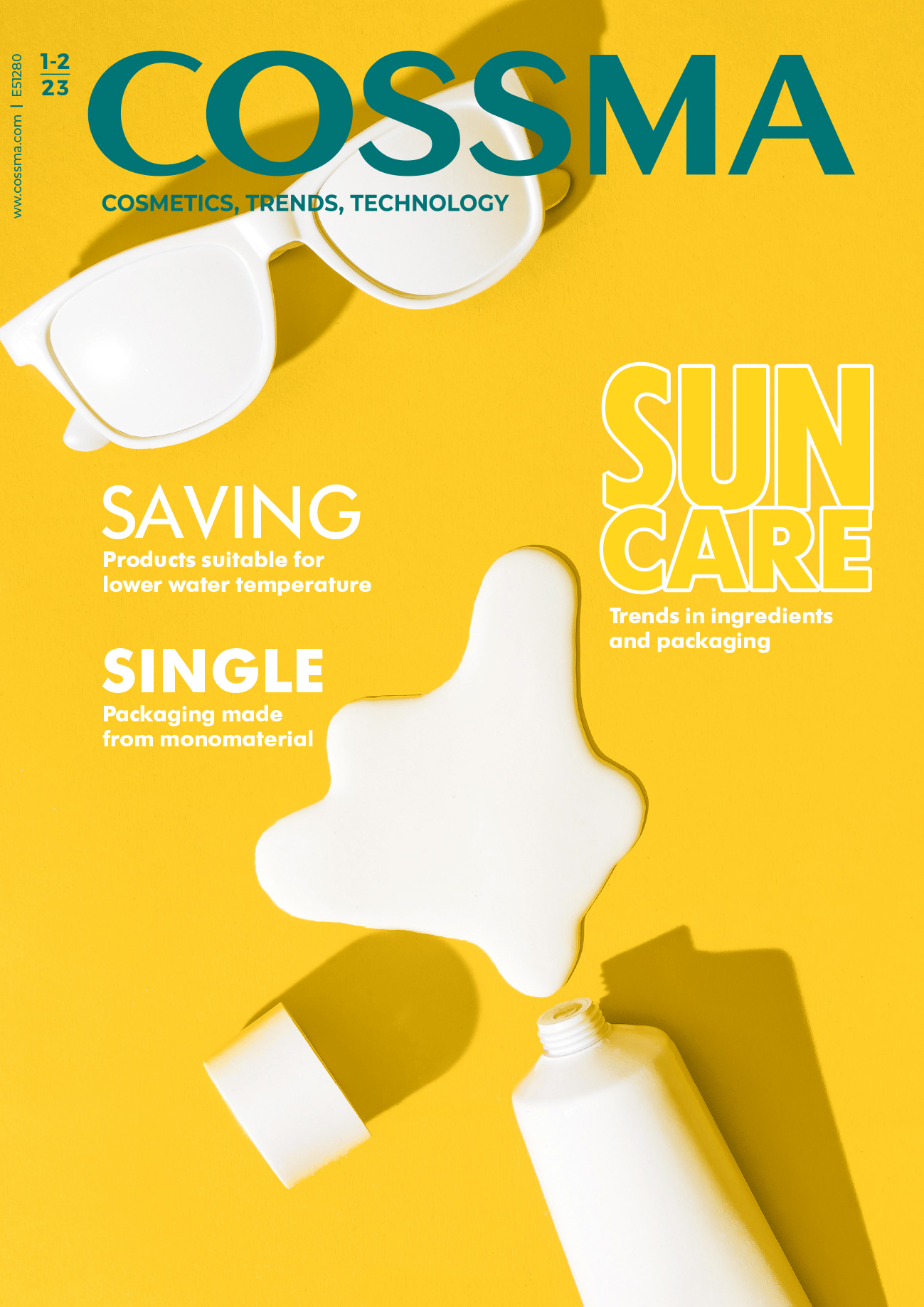
Issue 1/2 – 2023 Here is what you can look forward to in this issue: Saving: Products suitable for lower water temperature Single: Packaging made from monomaterial “Sun care”Trends in ingredients and packaging Get an e-paper subscription Issue 1/2 – 2023 Here is what you can look forward to in this issue: Saving:Products suitable for … Read more

National regulations in some places make it difficult to introduce sunscreens that are already classified as safe in other countries. Arnita Wofford reports on the difficulties of the current situation, also about how customer wishes can be fulfilled under these conditions.

The tasks of hair care have long since gone far beyond cleaning and detangling the hair. Sensitive scalps need to be cared for, curls should look beautiful and styling products have to protect the hair as well. This overview offers a selection of the latest formulations that reflect the current trends on the market.

Not least because many travel restrictions have been lifted, the market for sun care products is recovering significantly while demand is increasing. We present a selection of formulations and ingredient suppliers offering products for sun protection and post-sun care.

Since customers like to use products that are easy to use but have a variety of effects, the market for multifunctional active ingredients is growing more and more. Protection and care are also increasingly in demand when it comes to sun protection. Latest research results show that Dunaliella salina has special properties for this topic.
Not just the ingredients and the formulation are decisive for a good product. The manufacturing process also influences the quality. Ulf Sieckmann explains how a special technique can be used to achieve a high sun protection factor with little use of materials.

Since demands, legal requirements and customer wishes are constantly evolving for sun care products, continuous development is essential. Stanislaw Krus talks about the latest knowledge, safety, and quality standards.

The sun protection objectivation subject represents a complex issue between in silico, in vitro, in vivo and hybrid methods at least as important as the challenge of the formulation itself. Anne Charpentier explains different methods with their advantages and disadvantages.
Advertisement
BASF’s Care Creations® has introduced a new version of its Sunscreen Simulator, with an array of additional practical and convenient functionalities. Its new “cockpit” user interface and the integrated EcoSun Pass tool make it easier than ever for formulators to develop innovative, effective and environmentally conscious sun care products. The tool enables cost-effective, unlimited and … Read more
Advertisement
Sun creams are booming in the summer months because they protect the skin from skin ageing and even skin damage. We present a selection of formulations and ingredient suppliers that offer products for the whole body.
Advertisement

The interest of end consumers in inorganic UV-filters is rising as they are seen as being safer and a more natural alternative compared to organic UV-filters. However, also sun care products with inorganic UV-filters should fulfil certain customer needs such as nice skin sensory, non-whitening and non-nano. As experts in TiO2 and ZnO UV-filters Croda … Read more