
Packaging is responsible for much of the planet’s waste pollution and a contributor to climate change. Some of this comes from cosmetics packaging and it is an issue that the beauty industry is working hard to tackle. However, to be successful, it requires the collaboration of all parties in the value chain.
The impact of packaging on the environment is incontrovertible. Hundreds of millions of tonnes of plastic waste clog the planet, growing every day, around a third of which comes from packaging. Besides waste pollution and resource depletion, the sourcing of raw materials also causes harmful emissions. This is not a legacy we want to leave for future generations and the industry is working together on multiple levels to address climate change. Despite recycling efforts, beauty packaging in particular, literally ‘falls through the net’. Many fragrance, skincare and makeup items tend to be too small to be caught in the sorting trommels at recycling stations and end up in landfills or being incinerated. While legislation is slowly catching up to ensure responsible packaging and processes, there is much left to do on our journey to sustainability. What is certain is that there is a prevailing desire by all parties to change. In the beauty industry, we aim to lead towards a future where every product and its packaging enhances both individual well-being and the health of our planet.
Sustainability drivers
Beauty brands and packagers are driven by legal and consumer pressure, as well as their own commitment to sustainability. However, it is not easy to navigate new and upcoming laws, especially for global brands. Contradictory requirements in different countries and a general lack of clarity make it hard to know how to manage compliance, while new plastic taxes must be factored into pricing structures. The proposed EU Plastic & Packaging Wast
Beauty brands and packagers are driven by legal and consumer pressure
Regulation (PPWR) aims to streamline legislation across the European Union, though Spain has anticipated many of its requirements with the Real Decreto 1055/2022. Any confusion is compounded by myths, misinformation and wrong conclusions. New initiatives are emerging to help guide brands and consumers through the informational maze. Consultants, retailers and a new class of influencers are starting to post information online, while the industry is banding together to share data. The B Beauty Coalition, for example, has published the B Beauty Navigator, a working database with peer-reviewed best practice to help beauty companies and shoppers make more informed, sustainability-oriented choices. B Beauty Coalition is a collection of B Corp certified companies in the beauty industry. Benefit Corporations – or B Corps – form a growing community with the aim of using business as a force for good, with a strong focus on the environment. The B Beauty Coalition envisions a world in which beauty is not only skin-deep, but also regenerative. Through collective expertise, innovation, influence and action, it aims to create a ripple effect of positive impacts. There are numerous initiatives, collectives and certification programmes to guide companies in shaping and achieving their sustainable goals. In beauty packaging, EcoVadis is one of the leading ratings systems while, on a broader scale, companies are signing up to the UN Global Compact. Over the past years, its sustainable development goals have become part of the public consciousness, with clear, recognisable symbols denoting the specific commitment of participating organisations.

Examples for cosmetic packaging made of wood.
Eco-design
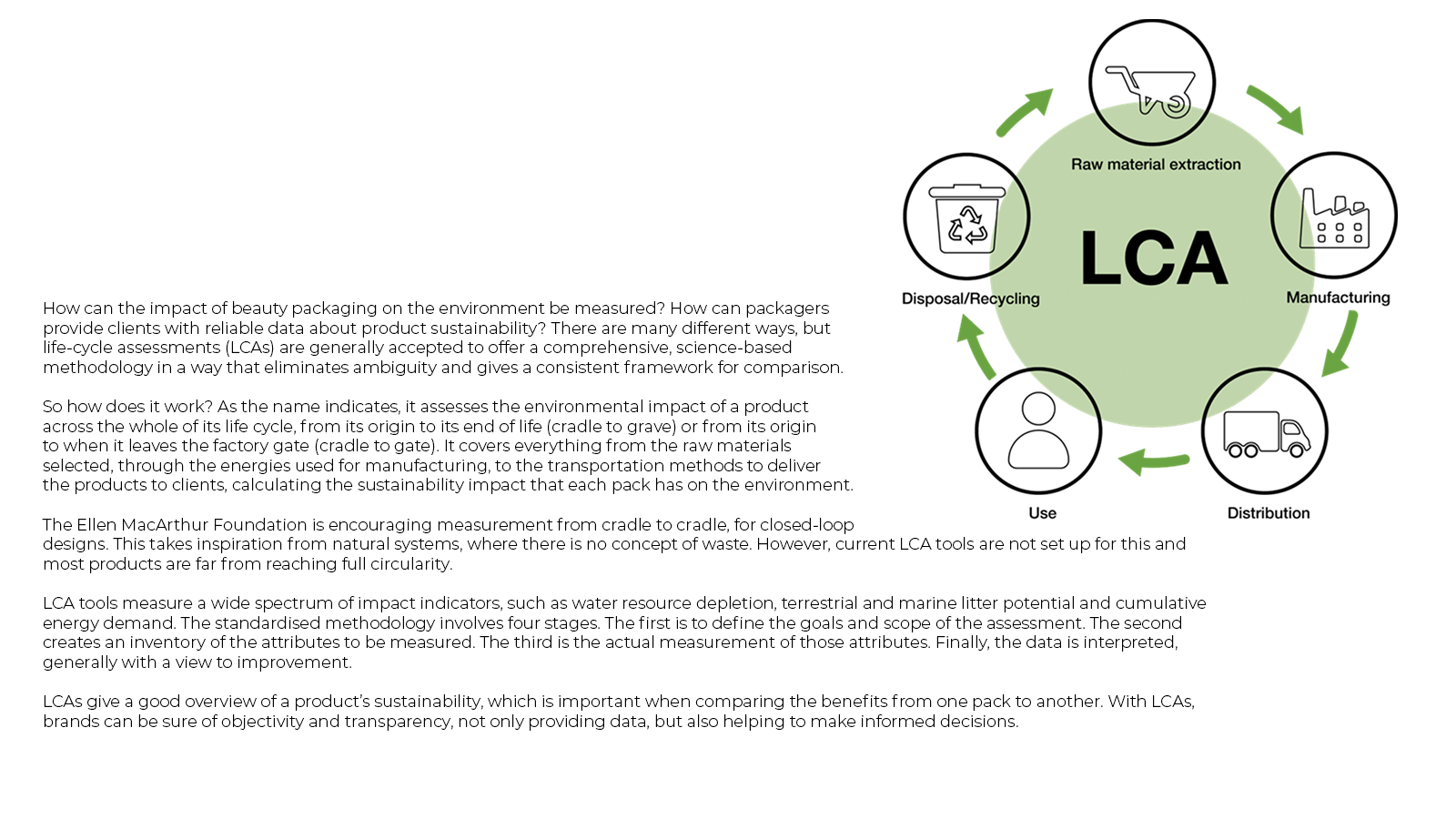
One of the key focus areas in sustainability is product design. Eco-designed solutions address the various Rs, such as reduce, reuse and recycle. Packaging companies are coming up with solutions that work on multiple fronts. Monomaterial designs facilitate recycling with higher-quality recycled materials and refill formats encourage a longer life span. Lightweighting is reducing the amount of material content in a single pack, while allowing improved logistics efficiency and a lower transport carbon footprint. Major strides are being made in material development, with bioplastics and biocomposites such as Sulapac ticking many boxes. Natural materials are being rediscovered, like certified wood and cork. Post-consumer recycled (PCR) plastics are increasingly incorporated into packaging. PCR is obtained through two main recycling systems – mechanical and chemical – although others are emerging, like enzymatic recycling. The latter breaks down plastic into the original monomers that allows it to be used in infinite loops; as there is no degradation in the material properties, it becomes as good as virgin material. However, this process must be scaled up before it becomes a viable solution. If or when it does, it could change the game for plastic as one of the most sustainable material options, even compared with cardboard and paper, which need a barrier that often contains microplastics. When regulations like the EU’s PPWR are introduced, what is certain is that demand for PCR will surge – and could possibly exceed supply. With so many approaches to eco-design, it can be hard for brands to select which products best align with their goals. To help guide their choice, some packagers publish life cycle assessments which provide fact-based data on the full impact of their solutions. These measure not just product specifications, but also processes, from material sourcing to manufacture and, in some cases, transportation and waste potential.
Net zero processes
It is clear that these processes have a big impact on the environment. Material obtention, conversion and transport all contribute to our collective carbon footprint. Different materials have different impacts. In the case of wood, sustainable forest management is successfully allowing responsible harvesting and ensuring an endlessly renewable supply. What’s more, it is increasing forested areas and acting as a carbon sink, absorbing CO2 from the atmosphere. Glass is made of natural and abundant raw materials, but takes much energy to produce and recycle and is heavy to transport. Aluminium requires mining. Some plastics can be recycled, but others cannot. It is a complex area with many trade-offs for brands and packagers to consider. Once obtained, we must next think of the material’s conversion into packaging solutions. Net zero manufacture is becoming a key objective for many companies. New practices are making it increasingly viable. Artificial intelligence and digital technologies are helping to improve machine performance through live data collection, optimising energy use. That energy can come from renewable sources, regenerative systems and biomass plants that use organic waste as fuel, all of which help reduce emissions. To reduce CO2 footprint from transportation, many brands are favouring local suppliers and sourcing from the region. Nearshoring is a growing trend, pulling supply from Asia back to Europe. Companies like Quadpack are either manufacturing or stocking components close to customers for local decoration and assembly, simultaneously accelerating time to market.
Closing the loop
The end of life of packaging is a crucial stage to manage, in order to mitigate climate change. How can we create circular solutions to avoid littering, landfill or incineration? Bigger brands and retail outlets are setting up collection schemes for reuse or recycling, often in collaboration with organisations like Terracycle or Pact in North America. Refillable packaging is gaining traction, albeit slowly, where consumers purchase refills or top up long-life packaging in-store. Recycling is the next best option for packaging that cannot be reused. Containers for glass, plastic and paper are ubiquitous, but is dependent on consumer behaviour. Not everyone recycles and, among those who do, not all put their waste into the correct recycling bin. Moreover, not everything that is collected gets processed into PCR material. Within recycling streams, there are still many challenges in getting materials prepared for processing at the sorting plants. Currently, small items like makeup packaging do not get captured by sorting machines at all and are treated as waste. There is a need for consolidation at the sorting stations of recycling plants. Moreover, certain types of plastic widely used in beauty packaging, like SAN, SMMA and PETG, cannot be picked up by today’s scanners. A consensus must be reached whether recycling streams are to include those types of materials or, as is more likely, we need to switch to using currently recyclable ones, such as PET, PP and PE. In any case, there is a lot of work to do, both to ensure that more consumers recycle and that the material collected actually becomes used. What is successfully sorted is then processed into new material by private companies for profit. Selling to Asia is no longer an option, so new waste regulations may be an incentive to boost local production.
An era of transition
Sustainability is a process, a continuous journey that requires the involvement of all parties in the value chain. Waste regulations and plastic taxes are a start, but we need to see evidence that authorities are using those taxes to establish domestic waste streams that can catch and process cosmetics packaging. The industry is being justifiably pressured and taxed, but that money must be invested correspondingly, in recycling technologies and facilities. Political agendas can get in the way, that do not always have the environment at heart. It is encouraging to see organisations like the ITENE research centre in Spain proactively developing solutions for waste management.
Consumers must be willing to recycle, too. An abundance of containers close to home helps, of course, but recycling should also be rewarded. Some countries have revived initiatives like consumer return schemes in the food industry and the beauty sector could introduce similar programmes for cosmetics packaging. Brands can further encourage reuse habits with lower price points for refills and loyalty points for returns. Packaging is only part of the story, of course. Formulators and brands have their own work in ensuring their products are not harmful to the environment. Indie brands are leading the way with natural, vegan and cruelty-free formulas and global beauty players are following suit. Sunscreens are coming out that are kind to ocean life, while big brands are phasing out harmful microplastics from their cosmetics. At the end of the day, we need to achieve an unprecedented level of collaboration, between government, consumers, brands, packagers and private recyclers. Tackling climate change and the waste problem requires a streamlined, global effort. It is complex, confusing and at times frustrating, but we are seeing new processes and habits emerge. We find ourselves in the middle of a transition and, if we all accept the challenge and work together, we can build a sustainable world for future generations.

Marleen Swart
Sustainability Director, Quadpack
www.quadpack.com