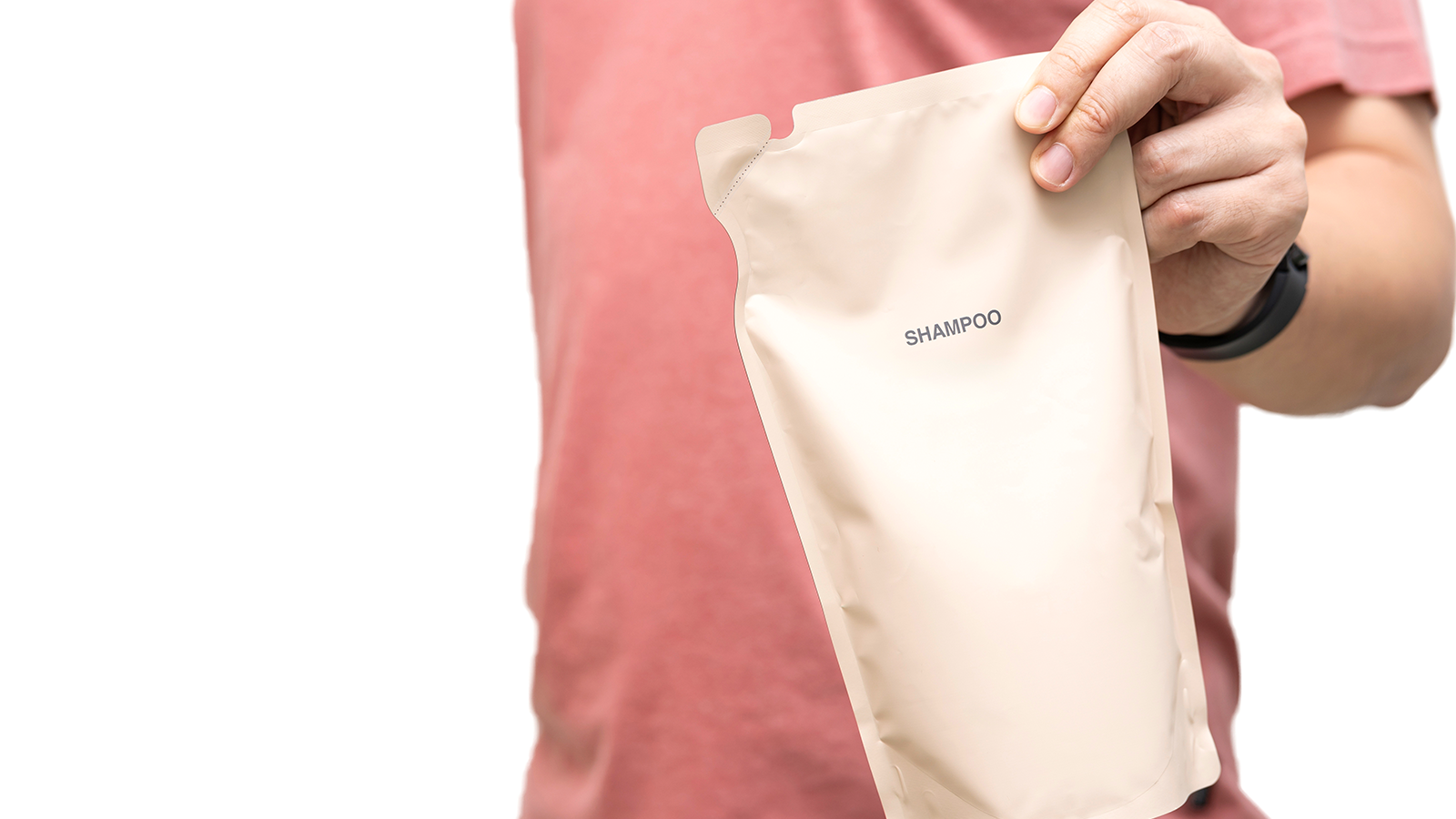
In April, the European Parliament approved the provisional agreement on the Regulation on Packaging and Packaging Waste (PPWR). Flexible Packaging Europe (FPE) sees flexible packaging as an innovative solution provider to minimize packaging and enable refill at home for cosmetics, detergents and other home products.
T he PPWR contains measures that will revolutionise the packaging industry, including a specific chapter containing the so-called “sustainability requirements” with market access requirements that will have to be demonstrated through an official conformity assessment in order to place packaged products on the market. In addition, the legislation focuses on the reduction of the generation of packaging through setting bans, reuse and refill targets.
Flexible packaging systems can save a lot of plastic and resources as demonstrated in this packaging-to-product-ratio.
Circularity of flexible packaging in the context of PPWR
All packaging will have to be recyclable by design by 2030 and at scale by 2035. For flexible packaging, this represents a challenging opportunity that the industry is ready to take. Design for Recycling (DfR) criteria will be set per packaging category through secondary legislation. The result of the recyclability assessment will be a scoring system that will mark the grade of recyclability of packaging. Such assessment will be based on some indicative parameters which include colours, material composition, inks, lacquers, printing. The targeted 55% recycling rate for flexible and films (and for other materials and categories) is now set as a market access condition as of 2035. The industry is ready to be ambitious by making sure all flexible packaging will be designed for recycling by 2030 and by paying its fair share of EPR fees, but Member States require the same ambitions in order to allow industry to meet the 55% target by setting appropriate infrastructures for collections and recycling of such packaging.
An important focus is also on boosting the use of recycled plastic content. For this reason, the PPWR sets recycled post-consumer waste targets for any plastic part in packaging, calculated per packaging type and format and as an average per manufacturing plant and year. To ensure the circularity of flexible packaging, FPE co-initiated CEFLEX which is a collaboration of over 180 European companies, associations and organisations representing the entire value chain of flexible packaging – incl. several global brand owners from the personal care and cosmetics sector. The joint target is to make all flexible packaging in Europe circular. Part of the legislation is also banning certain types of single use plastic packaging for specific applications. Those are certain single use packaging for cosmetics, hygiene and toiletry products for the use in the accommodation sector, intended for an individual booking only and intended to be discarded before the next guest arrives but also grouped packaging (such as collation films or shrink wraps) used at the point of sale to group goods sold in bottles, cans, etc.
Reduction of packaging: flexible packaging and refill pouches
Reducing the use of resources is the aim behind muchawaited mandatory packaging minimisation requirements in the PPWR. The flexible packaging industry is fully committed to sustainable use of resources having made resource efficiency its core principle, thanks to the very low packaging-to-product ratio which is usually 5 to 10 times lower than alternative solutions. In the future, the Commission will request the European standardisation organisation to prepare harmonised standards for calculating packaging minimisation and potentially specify maximum adequate weight and volume limits, and, if appropriate, even wall thickness for most common packaging types and formats. Flexible packaging has been used in refill systems helping to save resources and reduce packaging waste for a long time. But in the past years, those benefits were more recognised by brand owners and the packaging savings of using refill pouches even actively communicated to the consumers. Commonly, refill pouches are used for liquid soaps. Especially during the pandemic, when washing one’s hands regularly had become such an integral part of our lives, it was reassuring to know that refill pouches for liquid soaps helped to save significant amounts of resources – depending on the format up to 90% less plastic compared to rigid pump-bottles. The concept was also introduced for shampoo products when launching a more premium refill system containing a recyclable aluminium bottle with the regular refill pouches. Refiling these bottles uses about 60% less plastic per refill. Refilling the dispensers in hotel guest bathrooms or other public areas by using refill flexible packaging pouches are also an option to reduce the use of packaging. In addition to bans, the text contains ambitious mandatory reuse targets for transport packaging for all economic operators, reuse targets for alcoholic and non-alcoholic beverage sales packaging as well as voluntary refill targets for final distributors (i.e. retailers). The latter states that, from 1 January 2030, final distributors with a sales area of more than 400 m2 shall endeavour to dedicate 10% of that sales area to refill stations for both food and non-food products. This could also include cosmetics products, but the choice will be left up to each retailer. The definition of “refill” could also include refill packaging such as refill pouches (i.e. “refill at home”) in addition to the sale in bulk. If this interpretation of refill was to be confirmed, this refill obligation can potentially mean that retailers may shift to using refill pouches for some products such as detergents to meet the refill voluntary target or they could offer some products also in bulk. The substitution of rigid packaging formats by flexible packaging is generally minimising the use of resources for packaging. Using pouches for products like sunscreen might be unusual but can increase consumer convenience and decrease the environmental impact. All these examples demonstrate how flexible packaging supports sustainable production and consumption. Yet, whenever possible, reduced use of materials, as well as reduced energy consumption throughout supply chain, can result in a reduced environmental footprint. By being ightweight and having low volume, the energy used for transport and storage is minimised. Its packaging-to-product ratio is outstandingly low. A science-backed life cycle approach is always helpful to examine the real environmental impacts of a product
Next steps and reduction opportunities coming for the cosmetic sector
The PPWR should now enter the final stages of its final approval, which is expected by the end of the year. The flexible packaging industry is now looking forward to the next steps in the approval process. After the publication of the PPWR, the important phase of secondary legislation will start and industry urges a timely approval detailed rules on all sustainability requirements.

Guido Aufdemkamp
Executive Director, Flexible Packaging Europe, Düsseldorf, Germany,
www.flexpack-europe.org