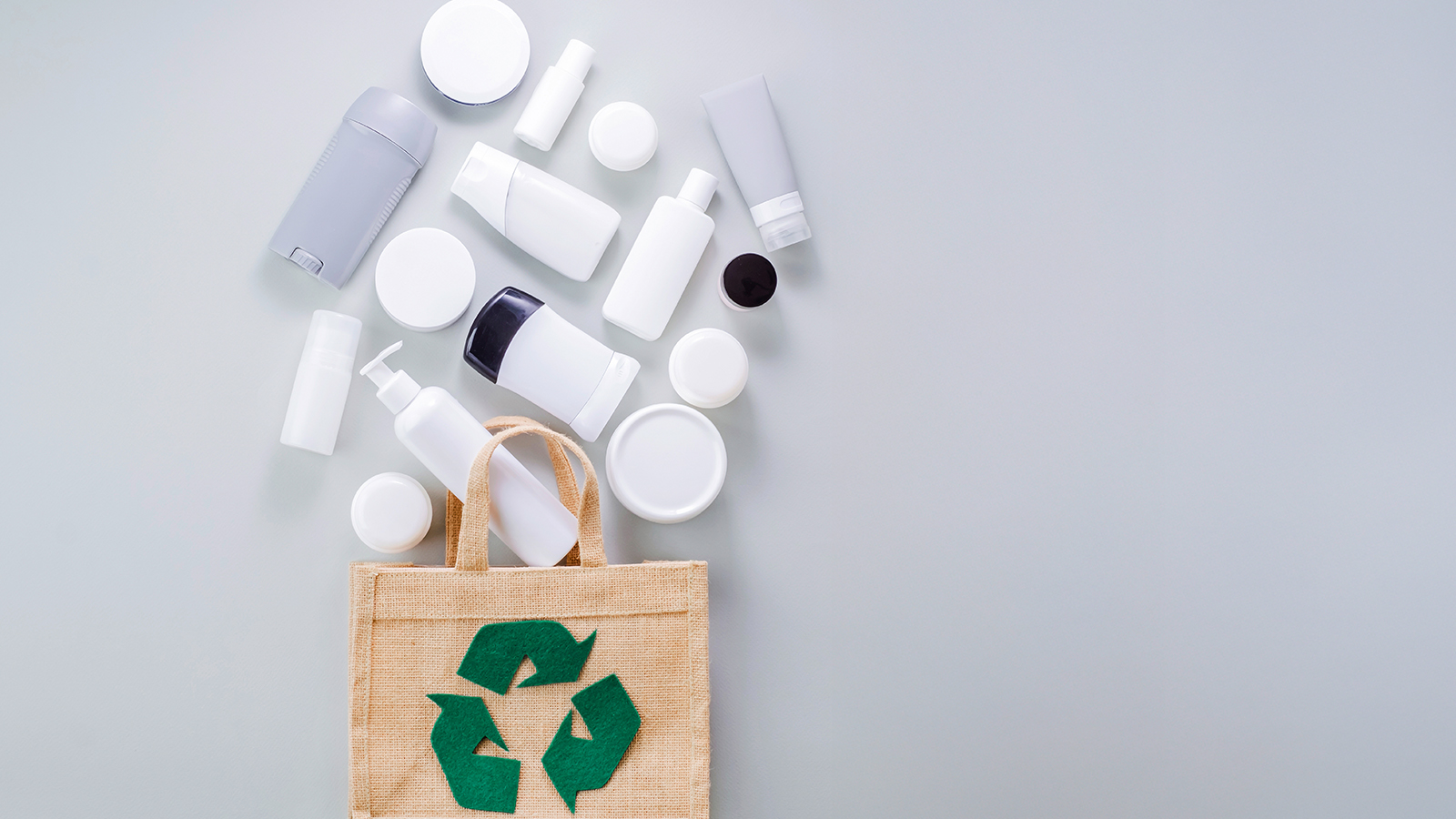
For quite some time, it has been known that recycled plastics are used as packaging material for food or cosmetics. However, the safety of quality and its definition of post-consumer-recyclates (PCR) has not yet been clarified all-purpose. In June 2024, the consortium of CosPaTox (Cosmetics, Packaging and Toxicology) published an initial and voluntary testing strategy. PCR should be analyzed as cosmetic packaging and to ensure safe use in accordance with European Regulation (EC) No 1223/20091.
A major problem with PCR compared to plastics which are directly fabricate from raw materials is an improper disposal by the consumer, who complicates a sorting and separation of plastic waste. If the plastics are too heavily contaminated, recycling is not possible.
However, even if the plastics are treated with printer ink, film, residues of other products or additives remaining on packaging materials, these processed plastics cannot be returned to recycling. Therefore, PCR must be tested for additives, foreign polymers, volatile substances and degradation products.
A conformity assessment according to Regulation (EC) No 10/2011 or (EC) No 1935/2004 allows the usability of materials for food.
It should be assumed that any food packaging is also suitable for cosmetics. The challenge here is to recycle plastics that were not originally intended for either cosmetics or food.
Cosmetic packaging potentially gets in contact with human skin, external intimate regions, oral and ocular mucosa and can irritate or penetrate them with particles. The skin’s natural acid mantle represents a certain barrier to prevent substances from entering the systemic circulation. Small molecules, abrasive particles, highly penetrating substances or the application of cosmetics to damaged skin nevertheless require special precautions. The PCR packaging must therefore have some smooth and sealed surfaces. Otherwise, small particles can detach and enter the product or onto the consumer’s skin. The physical properties of the recyclates must therefore be tested for rheological, abrasive or thermolabile behavior.
Recyclates must also demonstrate a resistance of odor and color to oils and solvents such as ethanol. They should not contain any substances that are volatile and hazardous.Regulation of REACH also advises strict monitoring of substances such as phthalates, heavy metals, polycyclic aromatic hydrocarbons (PAH), primary aromatic amines (PAA), per- and polyfluoroalkyl substances (PFAS), bisphenols and potential allergens.
According to Regulation (EC) No 1272/2008, no carcinogenic, mutagenic and reprotoxic (CMR) substances may be used for cosmetic packaging.
Previous microbiological contamination of the used packaging is also possible, such as spores or germ residues, which can remain on the PCR material even after heat treatment during recycling.
These sources of potential danger must be complied via various regulations and directives. Still no generally valid and standardized procedure by the EU has been described for practical implementation, so CosPaTox has investigated this issue.2
Methods
The analysis strategies created by CosPaTox are based on a lot of data from international cooperation. Their tools, which were published last year, included a list of substances of concern including limit values, a calculator for migration and margin of safety (MoS) and a guideline for the safety assessment of PCR.3
31 samples of recycled plastics were analyzed by bringing them into contact with three examples of cosmetics. The samples were polyolefin-based, such as polyethylene (PE) and polypropylene (PP), and were purchased from seven different manufacturers. The three cosmetic examples described a leave-on body lotion and two rinse-off products on an aqueous basis. Those were: shampoo and shower gel, in the latter case also suitable for children. Thus, the analytical test phase of the safety review was to investigate the migration of PCR into the cosmetic bases and the extraction from recyclates.
To test specific migration limits which are set exemplary in Regulation (EC) No 10/2011, ethanolic extracts (95 % Vol. like in the Cosmetic Packaging Guidance Document)4 were mixed with PCR. The chemical extraction of the PCR was carried out by dichloromethane.
The analytes were separated by gas chromatography (GC) or inductively coupled plasma (ICP) and detected by tandem mass spectrometry. The spectrums were compared to over 850 substances that could potentially be contained in PCR.
For the toxicological safety assessment, a mutagenicity test was also carried out for all samples using the microbiological Ames test.
As some substances bear an uncertain risk, the Threshold of Toxicological Concern (TTC) should be used. In general, the worst-case scenario for migration into the product was assumed and a maximum acceptable consumer exposure (MACE) evaluated.
Purpose
Regulation (EC) 2025/40 is intended to replace Directive 94/62/EC and stipulates a gradual increase in the proportion of recyclates in packaging by 2030 and 2040.The aim of the CosPaTox consortium is to establish a specification to bring recyclates into common use in the cosmetics sector in Europe.
Via their established tools, PCR manufacturers should assess results much easier and faster before placing them on the market.
As it is now increasingly attractive for companies to switch to sustainability and environmentally friendly production, many notable producers and trading companies support the CosPaTox consortium. In addition, scientific partner institutes such as the Fraunhofer Institute for Process Engineering and Packaging IVV,5 the FH Campus Wien, supported by the University of Paris-Saclay and the FABES Forschungs-GmbH of Munich, work on the preparation of the dossier.
The safety reports are scientifically tested, and the aim is to benefit consumers and eliminate any concerns about recyclates.
However, the new Packaging and Packaging Waste Regulation (PPWR) from 2025 is also intended to promise companies license fees for using recycled materials. An economic incentive needs to be created for the expansion of the recycling process.
Conclusion
The work of the CosPaTox dossier lays the foundation for a general evaluation and safety assessment of recyclates in the EU. Providing the labeling and traceability of waste sources like polyolefin-based plastics in accordance with EN 15343.
PCR materials such as polyethylene terephthalate (PET) can also be examined with CosPaTox safety assessments, but the database should be therefore expanded.
Likewise, the CosPaTox work did not consider the leave-on product group for the most vulnerable consumer group of infants and young children. Maximum limit values, restrictions and migration properties to use PCR for these tiny consumers are particularly important to check here. Revisions should be taken, otherwise cosmetic products for children should not be filled into PCR packaging as a precaution.
Furthermore, no statement was made about cleaning agents and detergents, because no product examples of these were examined. Higher surfactants and higher chemical contents could place different demands on PCR, which may require specific testing methods for this concern.
The question arises whether all testing laboratories have the necessary equipment or whether an analysis would also be performed with infrared (IR) or nuclear magnetic resonance (NMR), so measurement could expand in most laboratories. It would also be interesting for PCR manufacturers to establish a procedure for in-process-controls to recognize and eliminate potential dangers of the recyclates in an early warning system.
References:
1 Information available: https://cospatox.com/publication/, latest access: 08.01.2025
2 Dossier available: https://cospatox.com/wp-content/uploads/2024/04/CosPaTox-Dossier-April2024.pdf?v=1714391612, latest access: 08.01.2025
3 Guideline available: https://cospatox.com/wp-content/uploads/2024/04/CosPaTox-Guideline-April2024.pdf, latest access: 25.01.2025
4 Document available: https://initiative-frosch.de/wpcontent/uploads/2021/03/cosmetic_packaging_guidance_20210226.pdf , latest access: 10.01.2025
5 Article available: https://analyticalscience.wiley.com/content/article-do/chemische-und-physikalischeanalyse-von-pe–und-pp-rezyklaten, latest access: 05.02.2025

Eva Wiemann
Lemikos, Wiehl, Germany, www.lemikos.de