
The demand for natural ingredients is growing in hair care. Researchers have found that wheat proteins can replace chemicals that pollute the environment. Specialists look at this and the most innovative trends in personal care now.
Hair care is an important part of regular personal hygiene around the world. After all, healthy and shiny hair is considered to be a beauty symbol. No wonder that the demand for hair care products is high. Consumers expect benefits like easier detangling and styling, greater shine or better smoothness for their hair. These additional properties are brought into the formulas by conditioners. Among the most frequently used conditioners are quaternary ammoniums.
Those chemical cationic molecules act by anti-static effect, and have detangling, lubricating and sheathing properties. Not natural and mostly non-biodegradable quaternary ammoniums are considered to bring extra pollution to aquatic environments. There is, therefore, a need to provide clean and natural solutions for shampoos and conditioners that can replace modified guar polymers.

Natural ingredients in demand
Ecological and natural beauty are two of the biggest hair care market trends. Givaudan’s “Clean and Natural Study 2019” demonstrated that 91% of consumers are interested in the concept of clean beauty for hair care. In addition, they seek natural ingredients and products that are free from chemicals. According to the study, 80% of consumers find that wheat protein fits well with the idea of clean beauty for their hair, and 78% of them think the local wheat biomass is aligned with the concept. Researchers have developed wheat peptides, keeping in mind to these two fundamental pillars. By being 100% natural and crafted in one of the most important French farming regions, in a biorefinery platform, those wheat peptides answer consumer requests for a clean product that is not only good for the consumer, but also for the environment. As a suitable alternative to cationic guar, it acts as a conditioner to smooth and detangle hair. From wheat, a first protein fraction is obtained and purified to more than 80% of gliadins and glutenins, rich in essential amino acids. With a gentle enzymatic hydrolysis, the protein chains are cut into <2000 Da peptides, which are then purified. Various additional steps deliver a hydrolysate of very high purity. The hydrolysate has more than 20% active ingredient and has excellent substantivity on hair. Specific stabilization without the addition of any antifoam guarantees the absence of negative interaction in any type of galenics, such as shampoos or other foaming products.
Wheat peptides can bind to hair, giving an optimal level of conditioning and manageability. This natural ingredient can deliver the same level of performance as usual chemical conditioners.
Investigated Effects
Two double blind and placebo-controlled studies were carried out, each with 40 volunteers having Caucasian hair, and ageing between 30–50 and 20–60 years old. In each study, 20 volunteers applied placebo and 20 volunteers applied shampoo with the wheat peptides at 3% or Hydroxylpropyl Guar Hydroxylpropyltrimonium chloride at 0.3%.
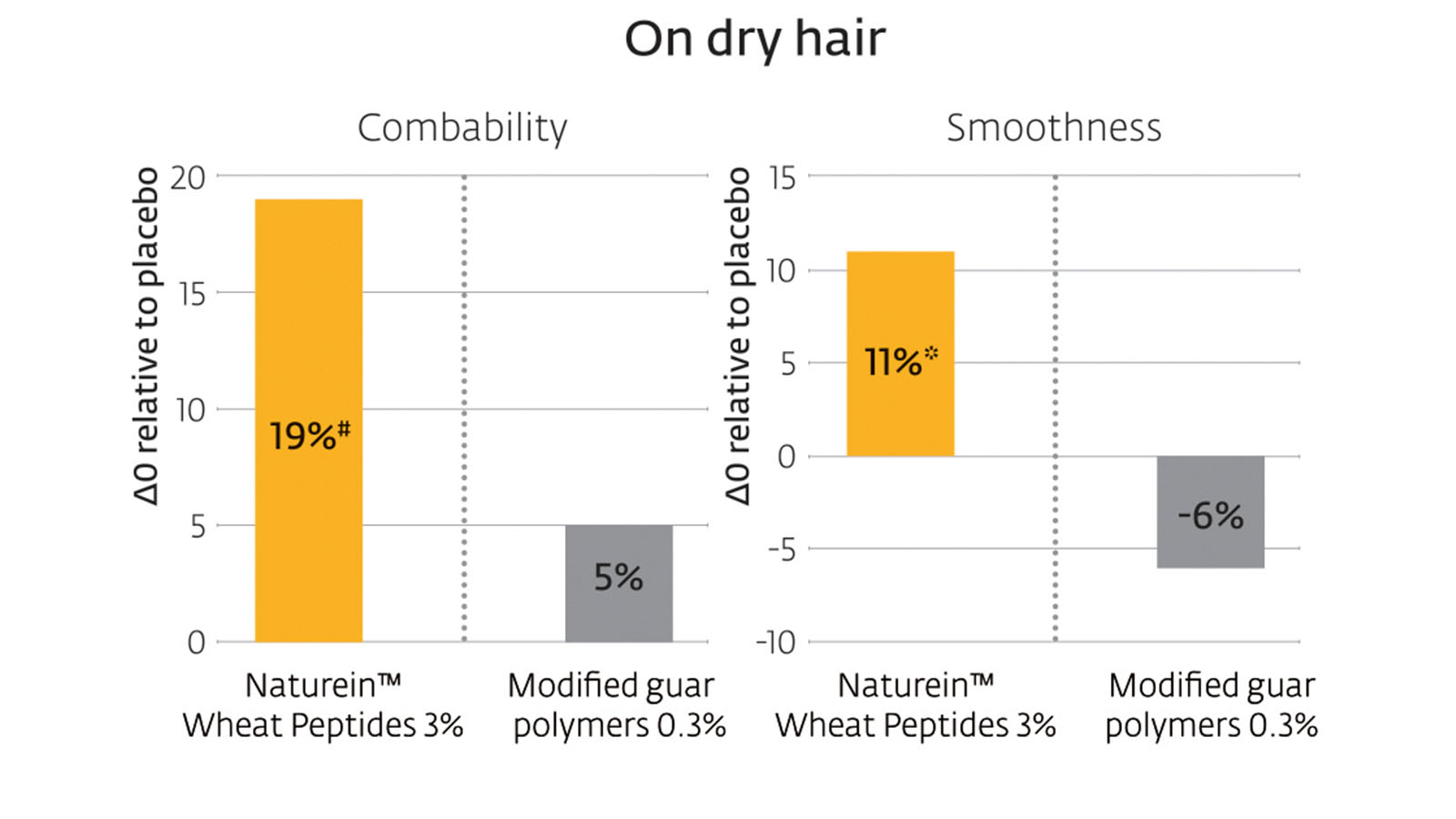
After a wash-off period of seven days with a neutral shampoo, volunteers applied the products every other day for 14 days. Clinical tests were further enhanced by a hair care expert who evaluated the impact on wet and dry hair. The results show that 3% of the wheat peptide extract significantly improved the detangling on wet hair (+20%), almost two times better than modified guars polymers. In addition, it significantly improved the combing on dry hair (+19%) and +16% on wet hair and smoothness of dry hair (+11% versus -6% with 0.3% cationic guar).
Two effective results were also perceived by the panel during clinical tests. In fact, 70-80% thought that their hair felt good and was easier to untangle after applying the active product. The wheat peptides can be used in many formulas, such as shampoo, hair conditioner, hair combing pre-shampoo and rinseoff mask.

Yohan Rolland, global category manager,
Romain Reyunaud, R&D director,
Amandine Scandolera, Ph. D,
head of biological evaluation,
Emilie Chapuis, clinical trial manager
Mélanie Pélican, communications specialist,
all Pomacle, France,
www.givaudan.com