Next-generation hair care increasingly treats scalp and fiber as one connected system. Ceramides provide a useful example: they are endogenous lipids associated with barrier organization in skin and the lipid architecture of hair, while biotechnology and delivery systems are opening new ways to formulate them for scalp and fiber care.
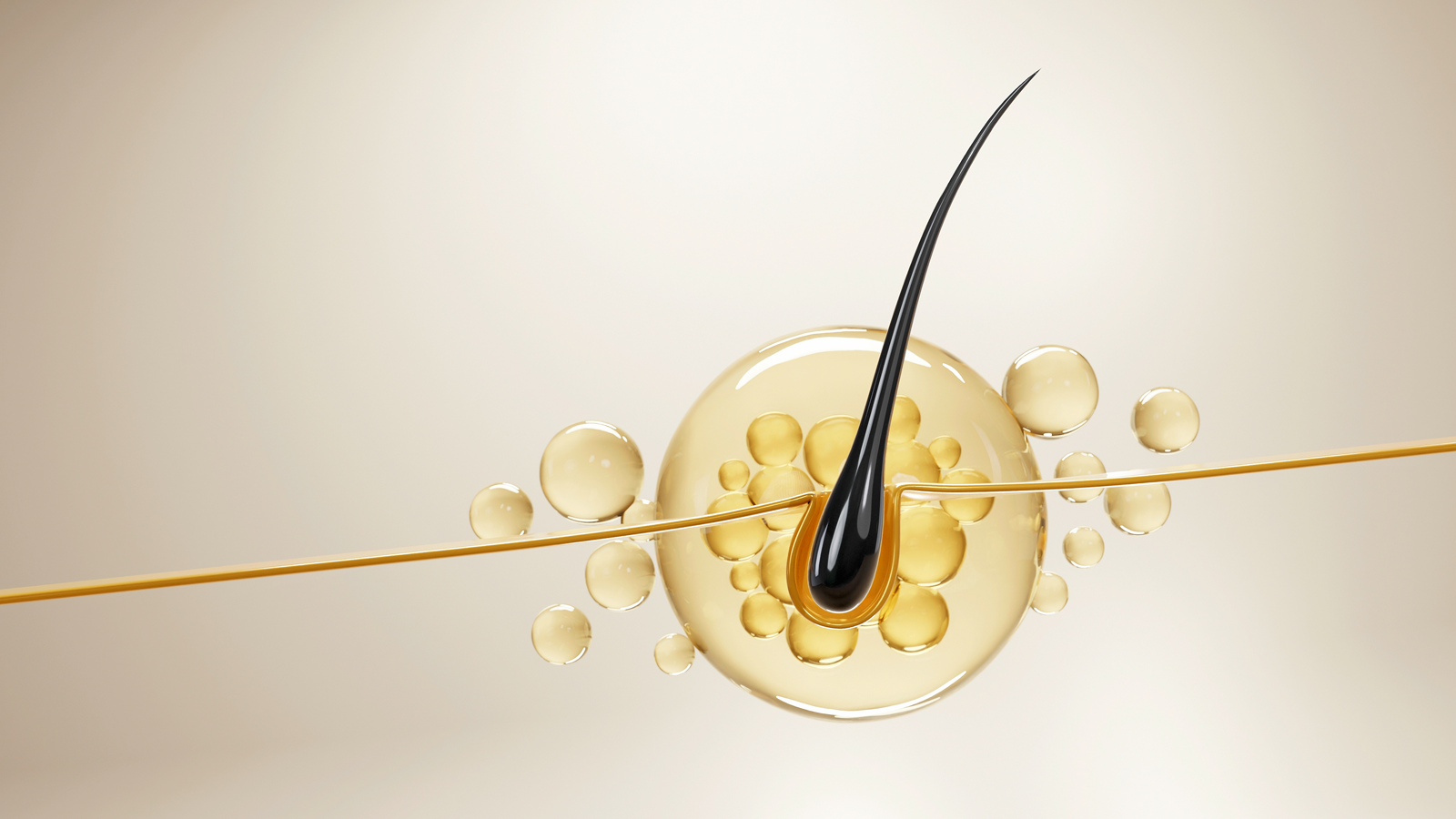
Hair care has traditionally been built around cleansing the scalp and conditioning the fiber. HairIntelligence suggests a more integrated approach. The scalp is a living barrier ecosystem shaped by lipids, sebum and microorganisms; the hair shaft is a keratin material whose behavior also depends on surface and internal lipids. Ceramides connect these two substrates. They are major components of the stratum-corneum lipid matrix and have also been isolated from human hair.[1] Studies of progressive hair weathering have reported changes in polar lipids, including ceramides, together with declining tensile properties.[2] This supports viewing ceramides not simply as emollients, but as biomimetic lipids relevant to both scalp-barrier and hair-fiber care.
Scalp Barrier and Microbiome
Scalp-microbiome research has moved the dandruff discussion beyond a single microorganism. Studies comparing healthy and dandruff scalps point to changes in bacterial and fungal communities together with host factors such as sebum and barrier condition.[3]
Ceramides are relevant to this host environment. A 2025 clinical evaluation combining scalp-barrier measurements, ceramide profiling and microbiome analysis found impaired barrier parameters and significant changes in ceramide composition in dandruff scalps, including lower Ceramide NP and Ceramide AP than in healthy scalps.[4] This does not prove that topical ceramides treat dandruff. It does, however, strengthen a broader formulation concept in which scalp comfort, barrier lipids and the microbiome are considered together.
For cosmetic developers, the question therefore shifts from simply removing dandruff-associated microbes to understanding how cleansing, sebum, barrier lipids and microbial ecology interact. Ceramide-containing scalp formulations can be developed around moisturization and barrier support, provided the finished-product claims are substantiated.
Ceramides for the Hair Fiber
The hair fiber provides a more direct efficacy story. Human hair contains endogenous ceramides,[1] and chemical treatment and weathering alter its lipid composition.[2] A particularly relevant study investigated a sphinganine-derived C18-dihydroceramide on chemically relaxed African-American hair. The ceramide bound to the fiber, and a shampoo containing it produced less breakage in a brushing-based test.[5]
This result also links ceramides with multi-texture hair care. Curved, chemically relaxed, bleached or repeatedly heat-treated fibers can face different combinations of friction, porosity and mechanical stress. Comparative work has shown differences in lipid composition, water behavior and mechanical properties among hair populations.[6] Future conditioning can therefore be designed around measurable fiber properties – curl, diameter, porosity, damage and lipid depletion – rather than assuming one system fits every texture.
Molecular specificity remains important. Evidence obtained with C18-dihydroceramide cannot automatically be transferred to every INCI ceramide. Ceramide NP, AP, EOP and other subclasses differ structurally, so finished formulations need their own performance data.
Biotech Conditioning
The “biotech conditioning” theme is relevant because fermentation and metabolic engineering can provide defined sphingoid building blocks for cosmetic lipid chemistry. Work with the non-conventional yeast Pichia ciferrii demonstrated engineered production of sphingoid bases / acetylated sphingoid bases such as TAPS and identified cosmetic and pharmaceutical applications as a target.[7]
Biotechnology therefore contributes more than a sustainability story. Controlled biosynthesis can support access to structurally defined lipid precursors and, in turn, more deliberate design of biomimetic ceramide systems. For hair care, this creates an opportunity to choose ceramide structures according to the intended scalp or fiber function, rather than treating ceramide as one interchangeable ingredient.
Encapsulation vs Micelles
Ceramides are highly lipophilic and difficult to disperse uniformly in water-rich systems, making the question of encapsulation versus micelles highly relevant. Micelles can improve apparent solubility in surfactant formulations, but in rinse-off products they can also create a deposition challenge: a solubilized lipid that remains with the cleansing phase may simply be removed during rinsing.
Structured lipid systems offer another approach. Ceramide-rich liposomes have been investigated on damaged hair and were associated with improved resistance to breakage.[8] In skin-delivery research, a 2025 oil-in-water nano-emulsion containing Ceramide C2 achieved 85% encapsulation efficiency and enhanced experimental ceramide delivery.[9] Earlier in vivo work with ceramide-containing positively charged nano-emulsions also showed improvements in skin hydration and elasticity.[10]These studies should not be over-extrapolated to shampoo. They illustrate a more useful principle: the carrier should match the target. On hair, deposition and substantivity after rinsing may matter more than penetration. On scalp, localization and residence time may be more relevant. The meaningful comparison is therefore not encapsulation is better than micelles, but whether the system solves the limiting problem of solubility, deposition, retention or release.
A More Precise Approach
Ceramides connect several strands of HairIntelligence: scalp-barrier biology with microbiome research, endogenous hair lipids with fiber conditioning, biotechnology with defined molecular structures, and formulation science with delivery engineering.
The opportunity is not to present ceramides as another universal hero ingredient. It is to use them more precisely: identify whether the target is scalp or fiber, select an appropriate ceramide structure, choose a delivery system that deposits the lipid where it is needed, and substantiate the finished-product claim.
In this sense, adding ceramides to hair care is more than borrowing a familiar skin-care ingredient. It is an application of lipid biology to smarter scalp and fiber systems – exactly the formulation logic that HairIntelligence describes.
References:
1 Hussler G, Kaba G, François AM, Saint-Léger D. Isolation and identification of human hair ceramides. International Journal of Cosmetic Science. 1995;17(5):197–206.
2 Duvel L, Chun H, Deppa D, Wertz PW. Analysis of hair lipids and tensile properties as a function of distance from scalp. International Journal of Cosmetic Science. 2005;27(4):193–197.
3 Saxena R, Mittal P, Clavaud C, Dhakan DB, Hegde P, Veeranagaiah MM, Saha S, Souverain L, Roy N, Breton L, Misra N, Sharma VK. Comparison of Healthy and Dandruff Scalp Microbiome Reveals the Role of Commensals in Scalp Health. Frontiers in Cellular and Infection Microbiology. 2018;8:346.
4 Bitton A, Idkowiak-Baldys J, Bouslimani A, Chun Wang EH, Paturi J, Chen Y, Clavaud C, Baalbaki N. A Clinical Evaluation of Scalp Barrier Function, Ceramide Levels, and Microbiome in Diverse Dandruff Patients. Journal of Drugs in Dermatology 2025;24(3):32731s3–32731s14
5 Bernard BA, Franbourg A, François AM, Gautier B, Hallegot P. Ceramide binding to African–American hair fibre correlates with resistance to hair breakage. International Journal of Cosmetic Science. 2002;24(1):1–12.
6 Martí M, Barba C, Manich AM, Rubio L, Alonso C, Coderch L. The influence of hair lipids in ethnic hair properties. International Journal of Cosmetic Science. 2016;38(1):77–84.
7 Börgel D, van den Berg M, Hüller T, Andrea H, Liebisch G, Boles E, Schorsch C, van der Pol R, Arink A, Boogers I, van der Hoeven R, Korevaar K, Farwick M, Köhler T, Schaffer S. Metabolic engineering of the non-conventional yeast Pichia ciferrii for production of rare sphingoid bases. Metabolic Engineering. 2012;14(4):412–426.
8 Méndez S, Manich AM, Martí M, Parra JL, Coderch L. Damaged hair retrieval with ceramide-rich liposomes. Journal of Cosmetic Science. 2011;62(6):565–577.
9 Zhou Y, Wu L, Zhang Y, Hu J, Fardous J, Ikegami Y, Ijima H. Topical Delivery of Ceramide by Oil-in-Water Nanoemulsion to Retain Epidermal Moisture Content in Dermatitis. Biomolecules. 2025;15(5):608.
10 Yilmaz E, Borchert HH. Effect of lipid-containing, positively charged nanoemulsions on skin hydration, elasticity and erythema – An in vivo study. International Journal of Pharmaceutics. 2006;307(2):232–238.
11 Commission Regulation (EU) No 655/2013.
12 U.S. Food and Drug Administration (FDA). https://www.fda.gov/cosmetics/cosmetics-laws-regulations/it-cosmetic-drug-or-both-or-it-soap
13 NMPA China. Cosmetics Supervision and Administration Regulation; 2026 registration/filing update. https://www.nmpa.gov.cn/xxgk/fgwj/flxzhfg/20250416144446121.html
14 MFDS Korea. Functional Cosmetics. https://www.mfds.go.kr/eng/wpge/m_24/de011014l001.do

Eduard Albrecht
Managing Director, PolyNeo GmbH,
Frankfurt am Main, Germany, www.polyneo.eu