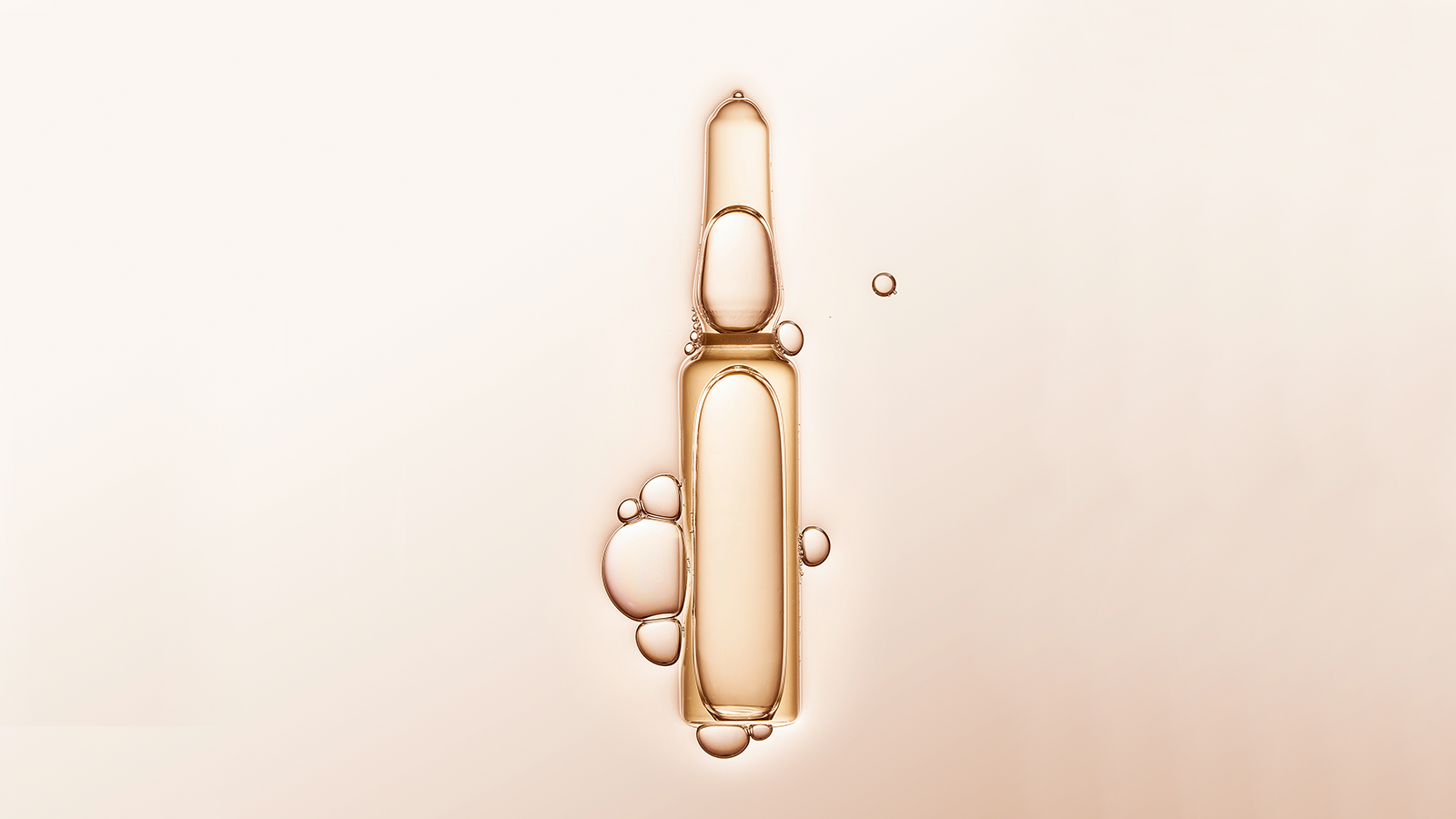
Consumers, now more than ever, want faster and more dramatic results from their skin care routines. Ampoules are one way of providing targeted active ingredients to the skin for one-off, short term or booster applications as part of, or in addition to, an established skin care regime.
Whilst ampoules can sound like a promising solution to consumer demands, their concentrated form can pose particular safety, stability and even regulatory issues. And of course, the delivery of the active is always of paramount importance! This article will look at what you’ll need to consider when formulating cosmetic ampoules, as well as how ampoules are formulated. It will also talk you through important dosage and safety considerations, so that you can formulate ampoules with confidence and get the best possible results for your consumers.
What is the size of your ampoule?
This one may sound simple, but it’s not! When you use the term ampoule, you would most commonly be referring to a small glass vial holding anything from 1 to 5 millilitres – but it may also be a gel pocket or sachet with a different (and then much larger) quantity. In addition, all cosmetic formulas are written up by %w/w – so not only could the volume of your ampoule vary with the packaging, but so could the specific gravity (relative density) and weight of input. This becomes one you’ll need to consider carefully as the size of your ampoule increases. Just how big (or small) the ampoule is could also impact application decisions, which then alter formulation considerations. So … make sure you are clear on the size of the ampoule before you start on the application and formulation steps.
How is your ampoule to be applied?
Before thinking about which actives you want to use in your ampoule formula, you will need to determine how the ampoule will be used. For example:
- Is it to be mixed with a base product just prior to application? If so, the ampoule formula must mix easily with the base product, as well as your choice of actives. For example, if your base product is an oil-in-water (o/w) cream, then your ampoule will typically need to be a water soluble active in a humectant or gel-serum base. If it were an oil soluble active, the ampoule would need to ensure homogeneity when mixing, and that could cause sensory issues with the base cream during application.
- Is it to be used straight, without dilution or mixing? If so, the ampoule base will need to ensure effective delivery of the actives. Most actives need a delivery vehicle (such as an amphiphilic base) to get past the stratum granulosum – otherwise they simply don’t work as well as intended. When applying straight to the skin without a base cream, you’ll need to run performance tests to prove efficacy. In addition, regulations and safety tests will need to be conducted to ensure consumer safety when actives are applied ‘straight’ or with relatively little dilution. Finally, you’ll need to consider what else a consumer may have applied before the ampoule, and what they might apply after – these could impact delivery of your actives and therefore the results obtained.
"The delivery of the active is of paramount importance."
- Is more than one ampoule intended for use each week? Since ampoules can be extremely concentrated, regular use could be potentially irritating for many skin types. Ampoules can be formulated to suit once or even twice daily use for a week or more – but this is not their typical mode of application. Remember to consider carefully how a consumer is directed to use the ampoule, especially the frequency of application, and beware of consumer misuse too. How often an ampoule is intended for use each week will impact your next formulation decisions.
How much active ingredient should be used in the ampoule?
Once you have clear briefing on the size of your ampoule, how it is to be applied and how often it will be used, you can then determine the actives for your ampoule formulation and their required concentration. Since your ampoule would normally be used in its entirety once opened, that entire ampoule becomes the application. Most consumers would use at most a quarter of a teaspoon of face cream per application; this is a mere 1.25 ml of product (approximately 1.25 grams of finished product). Since many ampoules are 1-2 millilitres, an ampoule could be double the regular amount of product being applied at any one time – and should help you see why safety testing is essential!
"A consumer seeking ampoule applications wants outstanding performance results."
Remember to adapt your calculations to the size of ampoule you will be using and consider its application method when writing up your ampoule formulation, because this guidance only suits a 1ml ampoule applied straight to the skin. Where your active is normally used at:
- 2% w/w in a skin cream, a 1ml ampoule should contain a maximum of 0.02 grams of active in 0.98 grams of serum or humectant base.
- 5% w/w in a skin cream, a 1ml ampoule should contain a maximum of 0.05 grams of active in 0.95 grams of serum or humectant base. Your ampoule may not need a preservative! Where it is a humectant only base, send the product for available water testing. If there is low available water (Aw<0.6), microorganism growth is inhibited and a preservative is not needed.
* Note: you will need to check that 1 gram of product fits in your 1 ml ampoule, as only water has a specific gravity of 1 and your volume of product compared to weight may differ enough in such small packaging as to make an assumed volume statement of 1 ml inaccurate.
Additional precautions when formulating cosmetic ampoules
As with all cosmetic formulas, the brand putting the product onto the market is responsible for the safety, efficacy and evidence of their supplied product. Make sure you are carefully checking:
- local country regulations for the ingredients used giving consideration to their actual input per each application.
- packaging and labelling instructions, to ensure safe and suitable use.
- potential for consumer misuse: some consumers think more is better! Will double the frequency of ampoule application risk their safety? Can you otherwise limit overuse?
- stability: it might be a small package, but product separation can still be an issue and highly undesirable!
And of course, make sure the ampoule is affordable for commercial purposes, and out performs a standard serum application, since they are bound to cost a lot more because of filling, packaging, testing and development issues. A consumer seeking ampoule applications is typically wanting outstanding performance results, so make sure your product truly delivers on its promises. Use these tips and run extra safety, stability and performance results and you’ll be ready to start formulating your cosmetic ampoules.

Belinda Carli
Director of the Institute of Personal Care S cience, Brisbane, Australia, www.personalcarescience.com.au