
The demand for sustainable beauty products is steadily increasing as consumers become more conscious of ecological practices. One significant step in this direction is the utilisation of natural materials derived from various upcycled processes, including food waste. In this article, Kshitija Tembhekar, Anjali Gholab and Rachna Rastogi highlight some of the common food wastes and actives derived from them as a ready resource for formulators.
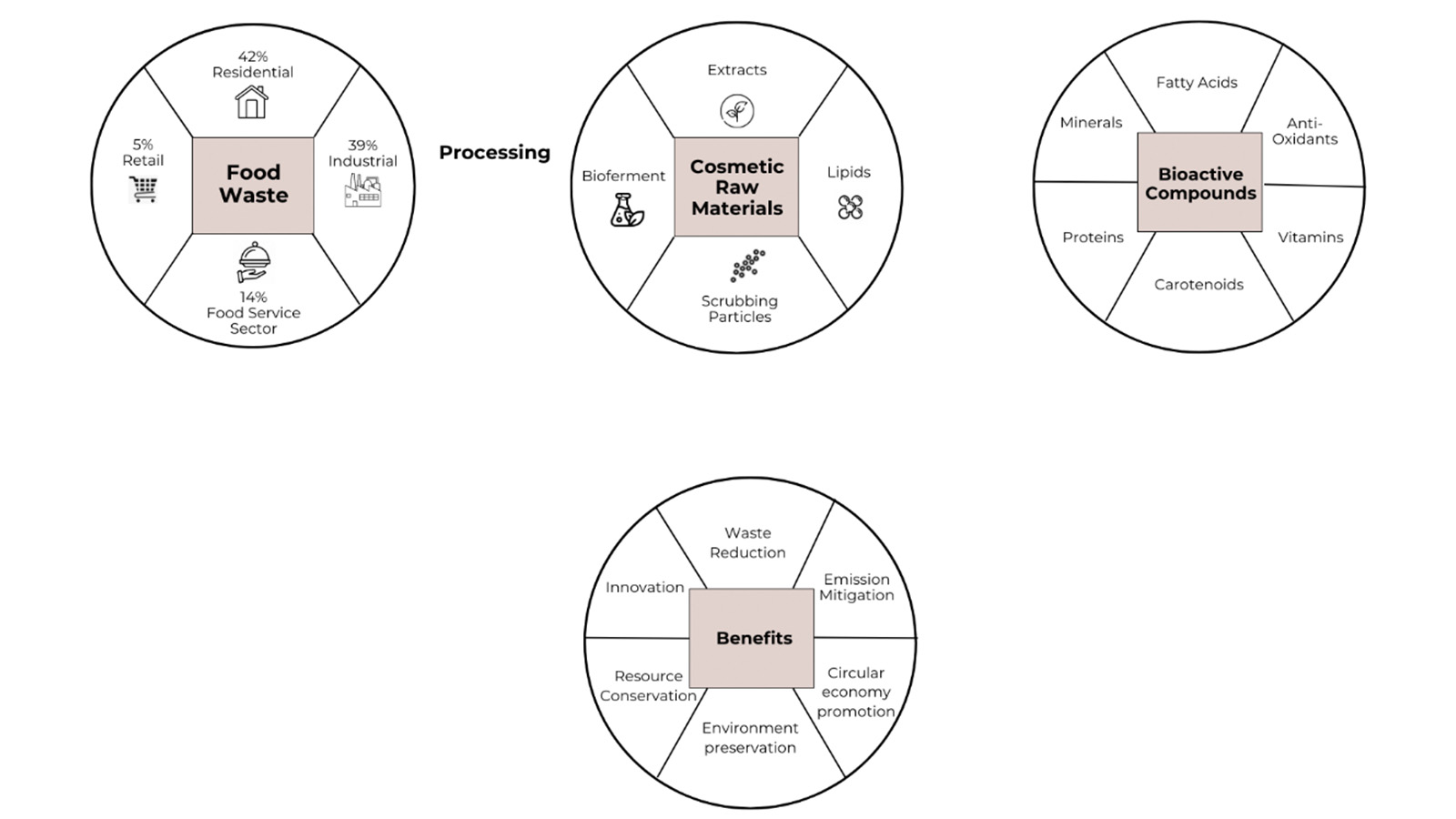
A significant portion of waste originates from various stages of the food life cycle, from agriculture to manufacturing, processing, and retail. In developed countries, 42% of food waste is produced by households, 39% of losses occur in the processing industry, 14% in the service sector, and 5% in retail and distribution. In countries like India, 67 million tons of food waste annually burden landfills. The repercussions of food waste on the environment are profound. Wasted food means wasted resources – precious fuel and water used in production are squandered, exacerbating environmental impacts. Irresponsible food handling leads to land degradation in both production and disposal phases, straining global agricultural resources. This degradation ultimately threatens biodiversity and food security as useful land is converted into landfills. When food waste ends up in landfills, it decomposes, emitting methane, a greenhouse gas, 28 times
more potent than carbon dioxide. This further affects the climate and contributes to biodiversity loss and land degradation.1
Repurposing food waste into usable materials not only reduces waste but can also decrease greenhouse gas production. One possibility is upcycling food waste for the generation of cosmetic raw materials. This process promotes circularity throughout the entire supply chain, reducing reliance on rare and expensive resources. Food waste encompasses a diverse array of residues, rich sources of biodegradable and skin-friendly ingredients for the personal care industry. These include proteins, polysaccharides, lipids, fibres, vitamins, phytochemicals, and minerals, providing various functional benefits like antioxidants, moisturising and anti-aging effects.1,2
Figure 1: Food waste transformation
Figure 1 illustrates the transformation of food waste into bioactive compounds for cosmetics. It begins with diverse waste sources, like agricultural residues and food processing by-products, undergoing extraction and fermentation. This yields raw materials abundant in bio-actives, utilised in skincare products. This process not only repurposes waste but also conserves resources and preserves the environment.
In recent years, interest in the health effects of natural antioxidants has increased due to their safety and applicability in cosmetic formulation. As the body’s outermost layer of protection, the skin is constantly exposed to external factors, mainly UV radiation and air pollutants. Oxidative stress then accelerates the aging process and causes the formation of wrinkles, hyperpigmentation, dryness, and loss of skin tone. The use of cosmetics containing antioxidant actives helps neutralise the formation of free radicals, thereby slowing down the visible signs of aging.3 Since food can be a rich source of antioxidants, in this review, we have focused on such materials from upcycled food waste.
1. Tomato
Tomato seeds are one of the most abundant residues due to the large production of ketchup4. The approximate chemical composition of tomato pomace (a combination of peel, seeds, fibrous parts, and pump), fibre (>50%), sugars (>25%), proteins (>15%), and some pectin, lipids, and minerals. Tomato pomace is also reported to be an excellent source of antioxidants including carotenoids, phenolic compounds, and ascorbic acid.5
Tomato peel also contains lycopene, which is a strong antioxidant whose concentration is up to five times higher in the waste peels than in the pulp6. Most of the reported health benefits of lycopene are attributed to its ability to protect cells against oxidative damage; topical application of lycopene before UV radiation exposure reduced photodamage5. In some studies, it is found to modulate cell growth and impart mutagenic properties4.
Food for Skin, a Netherland-based personal care brand, prioritises natural ingredients produced through upcycling their products. One of their bestsellers, the Tomato Base Cream, harnesses the antioxidant power of lycopene from tomato pomace, sourced from leftover seeds, peels, and liquid from an Italian pasta sauce factory.7 Also, Sollice Biotech, France, has introduced a range of actives (Intelligene) derived from upcycled organic tomato skin and seeds for skin soothing, moisturisation and skin conditioning, exemplifying innovative approaches to sustainability for the cosmetic industry8.
2. Olive
Production of olive oil generates massive amounts of waste, including olive oil mill wastewater (OMWW), olive pomace, and filter cake. Olive oil waste is heavily rich in polyphenols. In fact, during olive oil production, only 2% of the total phenols of olive fruit partition in the oil, while most phenols partition in the waste – 53% in the OMWW and 45% in the solid pomace.4
The main phenolic compounds in olives are as follows: hydroxytyrosol, tyrosol, oleuropein, verbascoside, hydroxytyrosol, and their derivatives. They are strong antioxidants. The leaves of Olea europea contain carotene, which is a natural pigment with high antioxidant capacity. Rich-in-carotene olive waste extract used topically on the skin reduces free radicals, prevents UVA damage in the skin cells, and shows anti-inflammatory effects. The compound has demonstrated use in barrier creams to prevent inflammation and repair the skin.6 Further research has proven these polyphenols to inhibit cancer cell proliferation and protect DNA from oxidative damage. Studies have also shown the antimicrobial potency of phenol-rich olive pomace powder, suggesting the use of olive oil production by-products for natural preservation.4
Recognising the untapped potential of olive waste, Gaia Tech, Germany, developed an Active Olive fruit extract, rich in the polyphenol hydroxytyrosol, known for its anti-aging and antioxidant properties9,10. Aligned with this sustainable ethos, Sophim, France, has embraced a circular approach to producing Phytosqualan (INCI: Squalane). Derived from upcycled by-products of olive oil production, the squalene rich fraction is used to produce squalane, a skin emollient, using green chemistry principles.11
3. Mango
Mango is a tropical fruit extensively cultivated worldwide. Its processing generates significant waste, with 30–50% of the fruit being discarded or used as animal feed. This waste primarily comprises of peels and seeds, with peels accounting for 7–24% of the fruit’s mass and seeds representing 20–60%. The kernel inside the seed constitutes approximately 45–85% of the seed’s weight.2
Mango seed kernels contain various antioxidant biomolecules, including carotenoids, tocopherols, and phenolic compounds like catechin, quercetin, anthocyanins, and gallic-, caffeic-, ellagic-, and ferulic acids. Mangiferin, a phenolic compound renowned for its super antioxidant properties, is also found in mango peels and leaves. Its anti-collagenase, anti-elastase, and anti-tyrosinase activities, indicate its potential use in creating anti-aging cosmetics.2
Beyond their antioxidant properties, mango waste is being utilised for other beneficial applications in the personal care industry. Innovative brands are increasingly recognising the untapped potential of mango waste, leading efforts to convert it into sustainable raw materials. One such brand Alzo International Inc., USA has upcycled mango seed waste into an emollient, Dermol MBDD (INCI: Dimer Dilinoleyl Esters/Dimer Dilinoleate Copolymer). This material exhibits unique viscosity and moisturising properties, providing hydration and protection for dry and sensitive skin.12 Also, Biolie, France has developed MangoBoost (INCI: Aqua, Pentylene Glycol, Mangifera Indica (Mango) Seed Extract), an extract from upcycled kernels using their patented enzymatic extraction eco-process to boost preservation in cosmetic formulations13.
4. Coffee
Coffee is one of the world’s most popular drinks and it has a strong commercial value, being second to petroleum as the most traded commodity worldwide. The coffee industry generates a large amount of waste, including unused coffee beans, spent coffee grounds, and silver skin/husks.4
Silver skin is a potential source of dietary fibre, protein, carbohydrates, caffeine as well as vitamins and mineral.14 Studies have shown the presence of antioxidants, particularly phenols and polyphenols such as caffeoylquinic acids, caffeic acid and ferulic acid in coffee grounds and silver skin4.
Caffeoylquinic acid derivatives have been known to have anti-melanogenesis and anti-tyrosinase activities as well as ROS scavenging activity15. Coffee waste extract has been studied for its antioxidant properties through various methods: in vitro tests to combat accelerated aging, in animal models to shield against UVB radiation, reduce photo-
aging, and promote skin repair, and in clinical trials to enhance skin hydration.4,16
Givaudan, Switzerland, has utilised this coffee waste and launched Koffee’Up. Marketed as an alternative to argan oil, the upcycled ingredient is made from spent coffee grounds. The ingredient has been developed in partnership with the Danish start-up Kaffe Bueno.17 According to their estimates, for every ton of oil extracted from coffee grounds, a staggering 56 tons of CO2 are saved from being released into the atmosphere.18 The Taiwanese company Hair O’ Right also introduced natural hair care products made from spent coffee grounds in 2006.17
5. Citrus fruits
During juice processing of citrus fruits, large amounts of by-products are produced. The food industry exploits only 45% of the total fruit weight, whereas the rest, such as peel (27%), pulp (26%) and seeds (2%), are disposed4,19. These can be a source of polyphenols i.e., flavonoids and phenolic acids, sugars, dietary fibres, proteins, lipids, organic acids, carotenoids, and vitamins.19
Several studies have shown citrus waste to protect or inhibit a series of mechanisms in skin models including antioxidant, anti-inflammatory, and antimicrobial activities. In particular, an orange peel extract, rich in flavonoids, protects skin cells from UV-induced inflammation. Also, citrus waste-derived nobiletin inhibited MMP-9 activity in human dermal fibroblasts.4 Research has shown that Citrus Reticulata (Mandarin Orange) peel extract exhibits anti-collagenase and anti-elastase potential, and California Navel orange peel (Citrus Sinesis) exhibits high anti-tyrosinase activity leading to lowering of melanin20.
Clariant, Switzerland, had developed Eosidin (INCI: Propanediol, Water, Citrus Unshiu Peel Extract), a powerful ingredient, derived from green citrus unshiu from Jeju Island in Korea. Eosidin acts on skin immunomodulation to soothe sensitive skin and alleviate atopic-prone skin conditions. In farming, hese green unripe fruits are normally discarded to promote the growth of remaining fruits. Unripe Citrus unshiu is rich in synephrine and hesperidin–highly potent molecules crucial in regulating the eotaxin synthesis process, responsible for histamine release.21 Also, Cargill Beauty, USA, extracted pectin from leftover lemon peel for skincare formulations17.
Conclusion
Globally, landfill management has become a pressing issue. Adopting sustainable practices such as upcycling food waste can help reduce the burden on waste management systems. This approach not only adds value for producers but also ensures better utilisation of agricultural resources. Additionally, such materials offer new solutions for cosmetic scientists in formulating sustainable beauty products. Increased collaboration between industries and the growing demand from consumers for circular beauty products that are beneficial for both people and the planet will shape the evolution of the upcycled cosmetics segment in the years to come.
References:
1 Azeez S, Narayana CK, Oberoi HS. Extraction and Utilisation of Bioactive Compounds from agricultural Waste. In: Utilisation of Bioactive Compounds from Agricultural and Food Production Waste. CRC Press; 2017.
2 Jaouhari Y, Travaglia F, Giovannelli L, Picco A, Oz E, Oz F, et al. From Industrial Food Waste to Bioactive Ingredients: A Review on the Sustainable Management and Transformation of Plant-Derived Food Waste. Foods. 2023 May 29;12(11):2183.
3 Kusumawati I, Indrayanto G. Chapter 15 – Natural Antioxidants in Cosmetics. In: Atta-ur-Rahman, editor. Studies in Natural Products Chemistry [Internet]. Elsevier; 2013 [cited 2024 Jun 24]. p. 485–505. Available from: https://www.sciencedirect.com/science/article/pii/B9780444596031000151
4 Cosmetics & Toiletries [Internet]. 2017 [cited 2024 Jun 24]. Garbage to Glamour: Recycling Food by-products for Skin Care. Available from: https://www.cosmeticsandtoiletries.com/research/methods-tools/article/21836720/garbage-to-glamour-recycling-food-byproducts-for-skin-care
5 Fărcaş A, Socaci S, Michiu D, Biris-Dorhoi S, Tofana M. Tomato Waste as a Source of Biologically Active Compounds. Bull Univ Agric Sci Vet Med Cluj-Napoca Food Sci Technol. 2019 Jun 7;76:85.
6 Krzyżostan M, Wawrzyńczak A, Nowak I. Use of Waste from the Food Industry and Applications of the Fermentation Process to Create Sustainable Cosmetic Products: A Review. Sustainability. 2024 Mar 27;16(7):2757.
7 What is upcycling in natural cosmetics? – Food for Skin [Internet]. [cited 2024 Jun 24]. Available from: https://www.foodforskin.care/en/blogs/blog-posts/wat-is-upcycling-in-natuurlijke-cosmetica
8 Natural, upcycled ingredients for sustainable skincare [Internet]. [cited 2024 Jun 24]. Available from: https://www.blagden.com/natural-upcycled-ingredients-for-sustainable-skincare/news/138
9 Scimetrica. Valuable raw materials from olive waste [Internet]. 2023 [cited 2024 Jun 24]. Available from: https://www.myscience.org/news/wire/valuable_raw_materials_from_olive_waste-2023-ethz
10 Gaia Tech AG | Upcycled Ingredients [Internet]. [cited 2024 Jun 24]. Gaia Tech AG | Upcycled Ingredients. Available from: https://www.gaiatech.ch/
11. Premium Beauty News [Internet]. [cited 2024 Jun 24]. Upcycled Olive squalane for Clean Beauty. Available from: https://www.premiumbeautynews.com/en/upcycled-olive-squalane-for-clean,18523
12 Dermol MBDD by ALZO International Inc. – Personal Care & Cosmetics [Internet]. [cited 2024 Jun 24]. Available from: https://www.ulprospector.com/en/na/PersonalCare/Detail/4700/236384/Dermol-MBDD
13 Mangoboost by BIOLIE – Personal Care & Cosmetics [Internet]. [cited 2024 Jun 24]. Available from: https://www.ulprospector.com/en/asia/PersonalCare/Detail/124756/6756228/Mangoboost?doc=1642698&st=1&bplogin=success
14 McDonald K, Langenbahn HJ, Miller JD, McMullin DR. Phytosterol oxidation products from coffee silverskin. PubMed [Internet]. [cited 2024 Jul 1]; Available from: https://pubmed.ncbi.nlm.nih.gov/35067916/
15 Kim HH, Kim JK, Kim J, Jung SH, Lee K. Characterization of Caffeoylquinic Acids from Lepisorus thunbergianus and Their Melanogenesis Inhibitory Activity. ACS Omega. 2020 Nov 20;5(48):30946–55.
16 Iriondo-DeHond A, Martorell P, Genovés S, Ramón D, Stamatakis K, Fresno M, et al. Coffee Silverskin Extract Protects against Accelerated Aging Caused by Oxidative Agents. Molecules. 2016 Jun 1;21(6):721.
17 ‘Upcycled’ Ingredients in Cosmetics [Internet]. Happi. 2020 [cited 2024 Jun 24]. Available from: https://www.happi.com/breaking-news/upcycled-ingredients-in-cosmetics/
18 Beveragedaily.com. beveragedaily.com. 2023 [cited 2024 Jul 1]. From skincare to shampoo: World’s first coffee biorefinery creates new uses for upcycled coffee grounds. Available from: https://www.beveragedaily.com/Article/2023/11/23/Coffee-biorefinery-creates-new-uses-for-upcycled-coffee-grounds
19 Russo C, Maugeri A, Lombardo GE, Musumeci L, Barreca D, Rapisarda A, et al. The Second Life of Citrus Fruit Waste: A Valuable Source of Bioactive Compounds. Molecules. 2021 Oct 2;26(19):5991.
20 Suri S, Singh A, Nema PK. Current applications of citrus fruit processing waste: A scientific outlook. Appl Food Res. 2022 Jun 1;2(1):100050.
21 Basel CL. Clariant Ltd. [cited 2024 Jun 24]. Eosidin®. Available from: https://www.clariant.com/en/Solutions/Products/2017/04/12/09/50/Eosidin

Kshitija Tembhekar
DPKA Universal Consumer Ventures Private Limited, Mumbai, India

Anjali Gholap
DPKA Universal Consumer Ventures Private Limited, Mumbai, India; Bregma Science LLP, Bangalore, India, www.bregma.org

Rachna Rastogi
DPKA Universal Consumer Ventures Private Limited, Mumbai, India; Bregma Science LLP, Bangalore, India, www.bregma.org