What does a glacier bacterium have to do with the ageing process of sleep-deprived skin? Christina Pickel from Mibelle Group Biochemistry explains.
Stress and a hectic lifestyle are becoming more and more common in today’s society and frequently result in lack of sleep. This is often markedly reflected on the skin: The face looks tired and shows visible signs of premature ageing. Importantly, it has been shown that insufficient sleep, just like UV radiation or oxidative stress, is correlated with reduced skin health as it weakens the skin’s ability to repair itself at night and thus accelerates skin ageing.
Molecular chaperones support protein folding
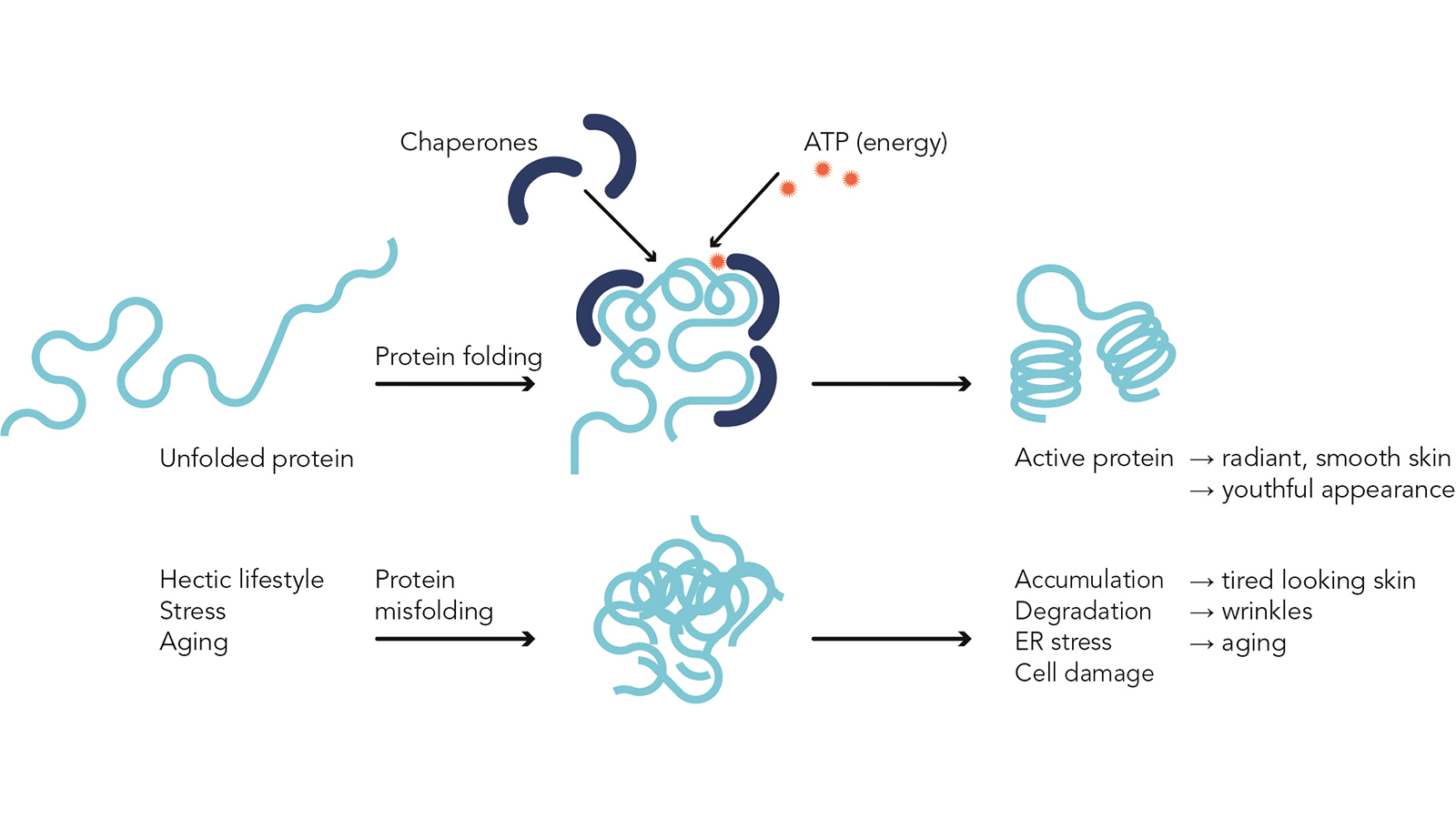
Sleep deprivation does not only cause a tired appearance on the macroscopic level but is also an ageing factor on the molecular level. The cause of this lies within our cells. When we do not sleep enough, the correct production of proteins in the endoplasmic reticulum (ER) is disturbed. For cells to survive and function properly, it is crucial that proteins are correctly folded upon production in order to then fulfil their function in the correct shape. This process involves helper proteins called chaperones, which assist in folding proteins. The need for chaperones to facilitate cell regeneration and repair increases upon cellular stress caused by lack of sleep is a process termed the unfolded protein response (UPR). However, recent research revealed that aged cells lose the capacity to activate the UPR, and the cells consequently fail to prevent protein misfolding and aggregation. This leads to an accumulation of wrongly folded proteins which further damage the cells (see fig. 1). To support the skin in coping with cellular stresses due to lack of sleep, our company developed IceAwake, a novel active ingredient for use in cosmetics.
A Swiss glacier bacterium for refreshing tired skin
Extremophile organisms are masters of survival as they are able to adapt to conditions generally considered as hostile to life. In order to thrive in conditions such as extreme temperatures, pH values or salt concentrations, extremophiles developed various strategies which help them to cope with these stresses. These include, amongst others, expressing enzymes that are active even at suboptimal conditions, and producing a large number of secondary metabolites with various functions. For this reason, extremophiles themselves represent interesting unique sources for secondary metabolites for cosmetic or pharmaceutical application.
In order to discover and harvest such extremophile microorganisms for use in cosmetics, our researchers undertook an expedition to a glacier in Valais, Switzerland. Due to the continuous shrinking of glaciers, microbes that have been hidden below permanent ice for centuries have become more and more accessible in the past decades. A sample of the soil exposed underneath the glacier was analysed for its microbial content. This is how the Iodobacter ssp. was identified.
After many years below the glacier ice layer, this cold-tolerant, rod-shaped bacterium has been reawakened and harnessed for the development of a novel active ingredient for skin care.
Following large-scale cultivation under optimised conditions and extraction of the Iodobacter ssp. strain, the extract is spray-dried on a maltodextrin carrier, resulting in the active ingredient IceAwake. The efficacy of this active to reduce ER stress as a cause of prematurely aged and tired skin was investigated in vitro and in vivo.
Iodobacter ssp. extract supports ER function
The effect of Iodobacter ssp. on the expression of several chaperones involved in protein folding in the ER was analysed in aged fibroblasts. After 24 hours of treatment with 1% Iodobacter ssp. extract, the expression levels of key chaperones involved in the UPR were increased by up to 100% in aged fibroblasts compared to untreated cells. Iodobacter ssp. is thus able to counter the age-dependent decline in chaperone expression and support cell regeneration and stress responses upon sleep deprivation.
In addition to causing ER stress, sleep deprivation also affects a second important cell organelle, the mitochondria. This results in decreased levels of ATP, the cellular energy currency which is also required to fuel chaperone activity (see fig. 1).
Moreover, physical interactions between mitochondria and the ER, so-called mitochondria-associated membrane (MAM) contact points, that are involved in the detoxification of accumulated misfolded proteins, are reflective of cellular stress. To assess whether Iodobacter ssp. also alleviates these signs of cellular stress, a second study was performed using cells isolated from an Alzheimer’s disease (AD) patient. These cells combine mitochondrial impairment and ER stress and therefore serve as a cellular model of sleep deprivation.
Treatment of AD-fibroblasts with 0.01% Iodobacter ssp. extract for 120 min led to a significant increase in ATP levels of 27.5% compared to untreated conditions. In addition, the number of MAM contact points, which was increased in AD fibroblasts compared to healthy control cells, significantly decreased upon treatment with an extract of Iodobacter ssp. Together, these results suggest that Iodobacter ssp. extract decreased ER stress in the sleep-deprived cell model.

Freshness kick for sleep-deprived skin
The anti-ageing and energising effect of our new active ingredient was further tested in two placebo-controlled clinical studies. Twenty-three overworked Asian women (aged between 41 and 57 years) with little and bad quality sleep were enrolled in the first study.
Volunteers were asked to apply a cream containing 2% IceAwake twice daily on one half of their face, and a placebo cream without the active ingredient on the other half of the face.
After just 14 days of treatment, the wrinkle depth of crow’s feet was significantly reduced by 11.4% compared to the initial conditions and the placebo product.
Moreover, skin radiance significantly increased by 9.2% compared to initial conditions, as evaluated by clinical expert grading.
A second study involving twenty-one female and male Caucasian individuals (aged 44-66 years) confirmed the effect of applying IceAwake twice daily on the wrinkle depth of crow’s feet.
Clinical-grade evaluation further highlighted a significant reduction of visible facial tiredness compared to initial conditions, which was observed in 71% of the volunteers after two weeks of treatment.
The reduction in wrinkle depth as well as the improvement of tiredness were also visible in photographs of male and female volunteers, see fig. 2.
Overall, these data demonstrate that after just 14 days of application, our active ingredient IceAwake rejuvenates tired skin by reducing wrinkle depth and visible signs of tiredness as well as increasing skin radiance.
Targeting a novel mechanism of ageing caused by lack of sleep, namely improving the flawless production of proteins and increasing cellular energy levels, regular treatment with this novel ingredient results in visibly rejuvenated skin and a fresh appearance in spite of living a hectic lifestyle.

AUTHOR:
Christina Pickel,
Study Manager
Mibelle Biochemistry,
Buchs, Switzerland
www.mibellebiochemistry.com