
Neurocosmetics is cosmetology acting on the connection between skin and the nervous systems. It represents a new holistic approach to skin well-being and human mental health. From the skin, to the heart, through the brain. This article will clarify the definition and among other things focus on clinical testing methodologies.
With the recent rise of wellness-related beauty products, attention is concentrated on developing neurocosmetic ingredients to combat skin stress and stress pathways, which are correlated with skin aging. It is becoming a focus segment in the beauty market, as the industry is actively looking for ingredients that could improve the interactions between the skin and the mind. In this article, we will clarify the definition of neurocosmetics, describe potential solutions and pathways, explore the range of wellness claims – relaxation, energy boost, happiness or concentration, and focus on the clinical testing methodologies supporting the proof of concept of such products.
Defining neurocosmetics
Neurocosmetics are defined as products applied on the skin that exhibit activity on the cutaneous nervous system or in general effects on skin mediators, combining skin benefits with emotional impact. The skin, a wonderful and complex organ, manages the relationships between us and the outside world. It is a dynamic structure in continuous transformation directly connected to the central nervous system. From the spinal cord, sensitive nervous or neuro-vegetative fibres innerve the skin, modulating thermoregulation, sebaceous secretion, or melanogenesis. Many emotions are felt at the skin level: fear, stress, and happiness manifest themselves in paling, sweating, goosebumps, raised hairs, blushing or radiance. The skin produces stimuli that, through mediators, are transmitted to the nervous system. These are chemical messengers, naturally synthesised by nervous fibre endings that are also produced by skin cells (keratinocytes, melanocytes, fibroblasts.)
The release of neuromediators can be induced by physical, chemical, or even emotional stimuli. Among the 200 neuromediators currently known, nearly 25 have been found in the skin. Some examples include neuropeptides, such as substance P, calcitonin gene-related peptide (CGRP), and bradykinins; neurohormones, such as melanocyte-stimulating hormone (MSH). The neuromediators’ level changes according to the person and their physiological or pathological circumstances. The binding of neurotransmitters to receptors induces the modulation of cell properties and skin functions (immunity, cell differentiation, proliferation, pigmentation). This interesting connection where the skin transmits and receives information from internal and external sources, induces the response of the neuroimmune-cutaneous-endocrine (NICE) system and is useful for understanding neurocosmetics as well as the related brain – skin connection for skincare.
From theory to formulation
To improve skin appearance and imperfections, neurocosmetic research is mainly focused on ingredients with structural analogies to endogenous neuromediators. Hence, when formulating neurocosmetics, the knowledge of the connection mechanisms between the skin and the brain should be useful in choosing functional ingredients able to interact with both systems, obtaining specific results. There are several mechanisms for Neurocosmetic ingredients. First, directly on the cutaneous nervous fibre endings, as modulators of the neurotransmitter release. For example, botulinum-like peptides that encourage facial musculature relaxation to obtain wrinkle-smoothing, and peptides that inhibit neurons, mainly used to make hypersensitive skin less reactive towards environmental factors like temperature changes, and humidity.
In addition, a mechanism to modulate non-nervous cells’ functions as agonist/antagonist molecules of the neuropeptide receptors or neurotransmitter effects modulators. A simple example is menthol and its derivatives, which can act on the skin as a physical coolant or a heat source, according to the used formulations, area of application, and amount used.
Chart 1+2:

Chart 3+4:

Chart 5+6:
Sleeping beauty
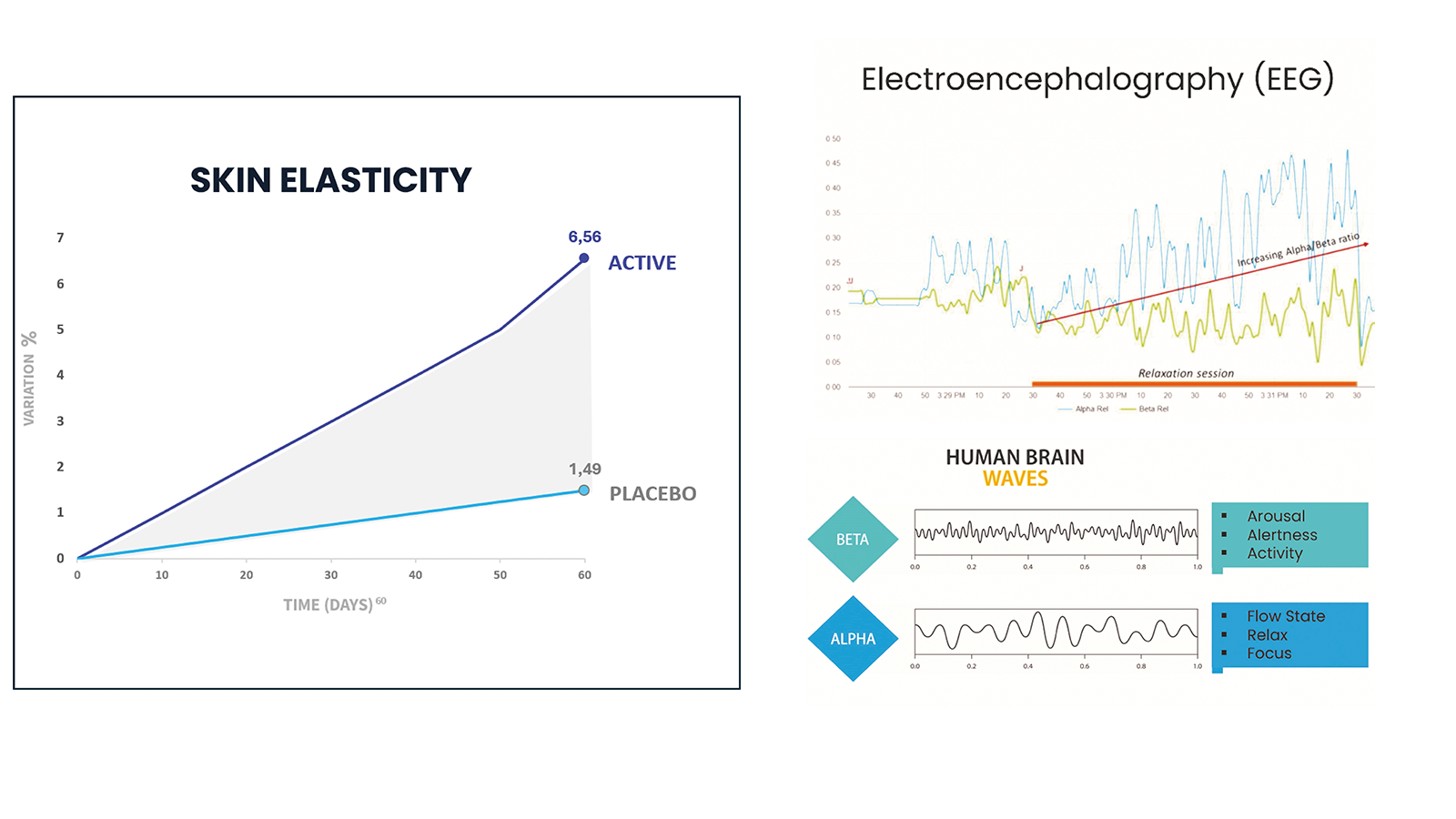
In our approach to connecting the skin and the mind, terpenes represent one the most interesting classes of molecules, considering their abilities to modulate Central Nervous System/Peripheral Nervous System (CNS/PNS) neural pathways, the skin enzymatic patterns and ectopic olfactory receptors. Translating this approach into a cosmetic ingredient is done via the application of essential oil complex on the skin, targeting to perform a biological action on skin with an additional emotional impact. As an example, we selected a new cosmetic active formulation based on a specific combination of selected essential oils. Each component was selected thanks to its unique benefits: Helichrysum italicum, Piper nigrum and Citrus sinensis endowed with anti-elastase1,2 and anti-collagenase (type IV)1 activities; Rosa damascena endowed with moisturizing activity3 and Abies sibirica and Lavandula hybrida grosso that demonstrate anti-tirosinase4,5 activity. In vivo tests were performed on 20 volunteers, by applying on the two halves of the face a 0.5% w/w emulsion of the above system vs. a placebo emulsion for 56 days. The results show a statistically significant improvement of the skin complexion, 6% increase of skin elasticity, 8% compactness improvement and 9% decrease of roughness, while skin whitening was improved in the 50% of volunteers (charts 1 – 5).
Measuring emotions
Skin benefits are only part of the holistic approach, and at that point, we turn to the emotional impact – the wellness effect. For a pointed use in night treatment, R. damascena, P. nigrum, Boswellia carterii and C. sinensis showed anxiolytic and sedative activities while C. sinensis, H. italicum and R. damascena were able to modulate PNS by decreasing respectively salivary cortisol and heart rate, systolic pressure and respiratory rate. On the basis of the most recent literature, geraniol and citronellol from R. damascena decreased the expression of the keratinocytes OR10A6 and OR2W1 respectively, modulating the skin stress and re-epithelisation. Such expectations can be evaluated in a clinical study which goes beyond the skin benefits and is concentrating on the emotional effect. With such new methodologies, we can identify and quantify the long- and immediate-term effect. In this study, the impact was evaluated by EEG method; vocal and verbatim analysis, proving the scientific benefits of the neurocosmetics solution. The data, analysis, and quality control were performed by the neuroscience experts from Emopsin – Spincontrol. The first test evaluated cognitive wellness, by measuring and analysing cerebral wave rhythm by Electroencephalography (EEG). As can be seen in chart 6, at a dosage of 0.5% the solution introduced demonstrated relaxing effect. The Alpha /Beta power ratio corresponds to a 16.33% increase between T0 and T7, which shows a long-term effect. A second test analysed the semantic production of subjects using the formula. More specifically, responses to a specific question were considered such as “What are your impressions regarding this product?” the results of a factorial analysis of correspondence (FAC) and post-hoc, t-tests-based statistics show Linguistic easiness when all volunteers used positive terminology regarding product’s sensory characteristics and smell. As this is done right after application, it proves short-term effect. This aspect was complemented by an additional test: Scrapbooking Implicit Task (SIT), which asks subjects to quickly select one picture among a sample of three, regarding their current feelings. All pictures are “calibrated” not only in terms of semantic categories, but also in terms of emotional dimensions.
In this study, three categories were considered:
• the focal category: “Relaxing & Calming”
• one positive control: “Serenity”
• one negative control
An analysis after seven days showed a 13.6% improvement in Relaxing / Calming effect. The last test was Evaluation of Behavioral Component, measuring 3 parameters: vocal intensity (dB); frequency (Hz) and regularity/ tonality vocal. Those are measured before and after allocation. The analysis shows Very positive elicited emotion, Slightly de-arousing, and 100% consensual positive responses. The emotional tests show both short- and long-term impact to the ability of the subject to relax. In combination, the skin benefits through brightening. The product is defined as an ideal candidate for a night beauty regime, promoting healthy brighter skin as well as relaxation and positive mood.
Conclusion
In conclusion, the specifically designed product described in this study is proven to be a new cosmetic active, effective in the treatment of major skin issues, while also possessing the ability to interact with CNS/PNS and ectopic skin nerve receptors, representing a new neurocosmetic approach to the well-being of the skin and overall relaxation of the person. Recent industry reports confirm what professionals in the personal care industry have been sensing for a while: Natural ingredients and soft claims are transitioning to the solid ground of clinically proven efficacy. Consumers are becoming more sophisticated in their quest for health and well-being, and that shift is impacting all of us –consumers, cosmetic manufacturers, beauty brands, and the ingredient suppliers who are working to develop such solutions. The new wave of neurocosmetics, supported by new technologies that prove there are dual skin and mind benefits, is the right direction. It gives our industry the chance to bring a new meaning to self-care and beauty-from-within.
References:
1 1. Fraternale et al., Journal of Medicinal Food, 2019,1041-1046
2 Mori et al., Journal of Cosmetic Dermatology, 2002, 1, 183–187
3 Sarkic et al., Cosmetics 2018, 5, 11;
4 Kim et al., International Journal of Cosmetic Science, 2013,35, 484–490
5 Aumeeruddy – Elalfi et al., South African journal of Botany, 2016, 103, 89-94
6 Hajibagheri et al., Complementary Therapies in Clinical Practice, 2014, 3, 159–163
7 Ghosh et al., Heliyon, 2021, 7 (4), e06884
8 Okano et al., Journal of Oleo Science, 2019, 68, 10, 1003–1009
9 Lehrner et al., Physiology and Behavior, 2005, 86(1–2), 92–95
10 Jafarzadeh et al., Advanced Biomedical Research, 2013, 2, 1, 1-7
11 Tonkovtseva et al, Bulletin SNBG, 2016, 118, 29-33
12 Hongratanaworakit , Natural Product Communications, 2009, 4(2), 291–296. 13 Duroux et al., Molecules, 2020, 25, 4743

Roberta Donadelli
R&D Manager, Sharon Personal Care,
Milan, Italy,
www.sharonpc.com
Naama Eylon
CEO, Sharon Personal Care,
Milan, Italy,
www.sharonpc.com