
Medicinal plants are an important ingredient for skin care. The following plants were chosen for Weleda’s Skin Food series one century ago: marigold (Calendula officinalis), camomile (Chamomilla recutita), wild pansy (Viola tricolor), and rosemary (Rosmarinus officinalis). This article presents an anthroposophical understanding of this plant composition. Part one (published in COSSMA 4/2024) focused on marigold and carmomille, while this second part will highlight wild pansy and rosemary.
To begin with, plants appeal to human beings most directly through their flowers, and it is through their flowers that they can be recognised and identified with the greatest certainty. However, studying foliar development and the change of form from leaf to leaf as they appear on the plant (the metamorphosis of leaves) is particularly well-suited for recognising and comparing the life forces that are active in plants and that are specific to each species.1 Based on this foundation, we have studied the four medicinal plants that are united through their extracts in Skin Food.
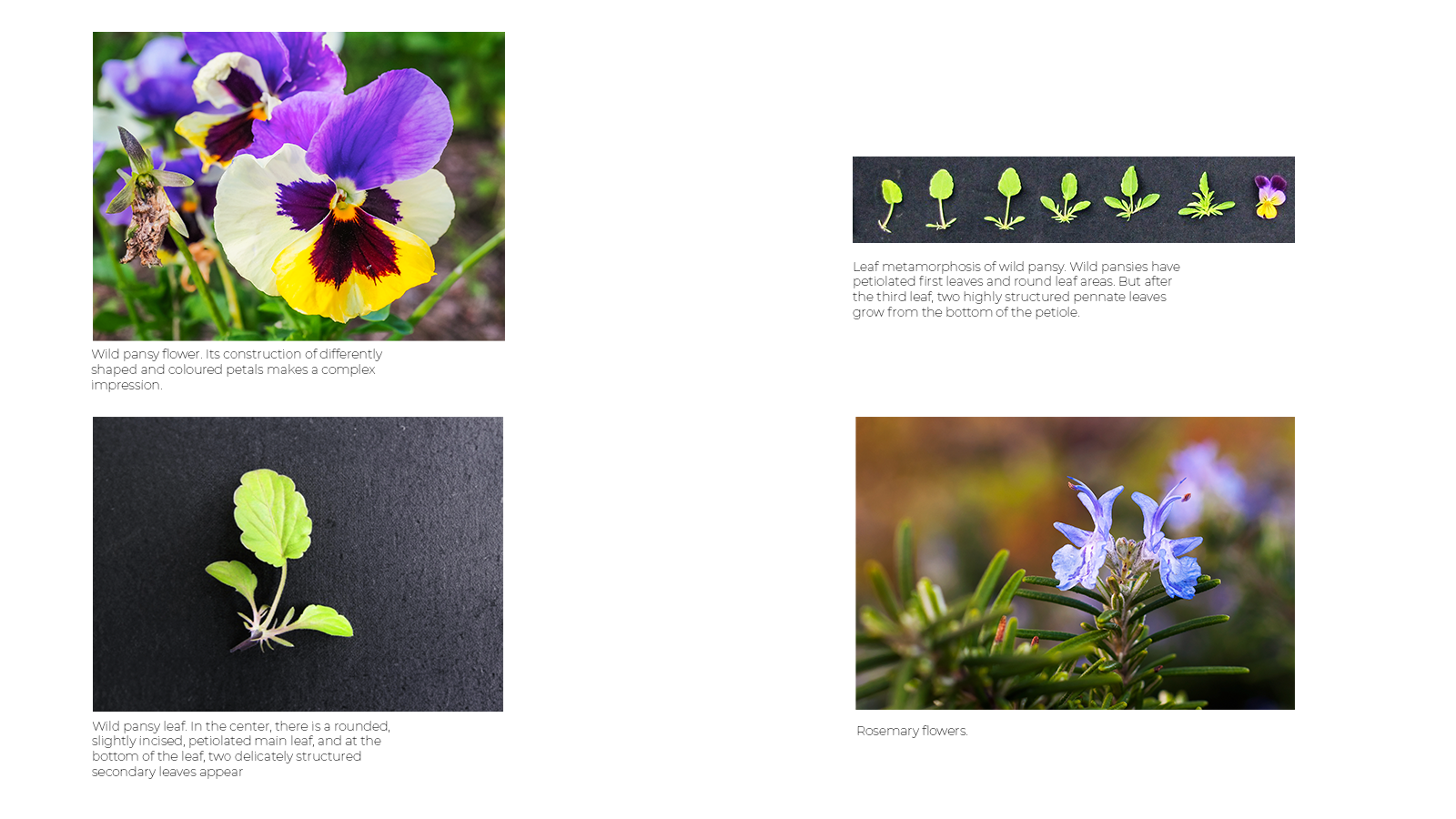
Wild pansy (viola tricolor)
Wild pansy is a small plant with a marked rosette. Its complex flower, with petals in different colours and shapes marked with dark stripes, stands out distinctly. Here, the developmental movements of spreading and pointing interpenetrate each other intensely and a leaf with a complex structure emerges. The leaf gives a very lively and interesting impression. The rounded and the strongly structured developmental movements seem to balance each other – we experience harmony in the interplay. In the leaf metamorphosis of wild pansy the opposite formative movements of spreading and pointing unite in distinctive parts and create an expressive form.
Rosemary (rosmarinus officinalis)
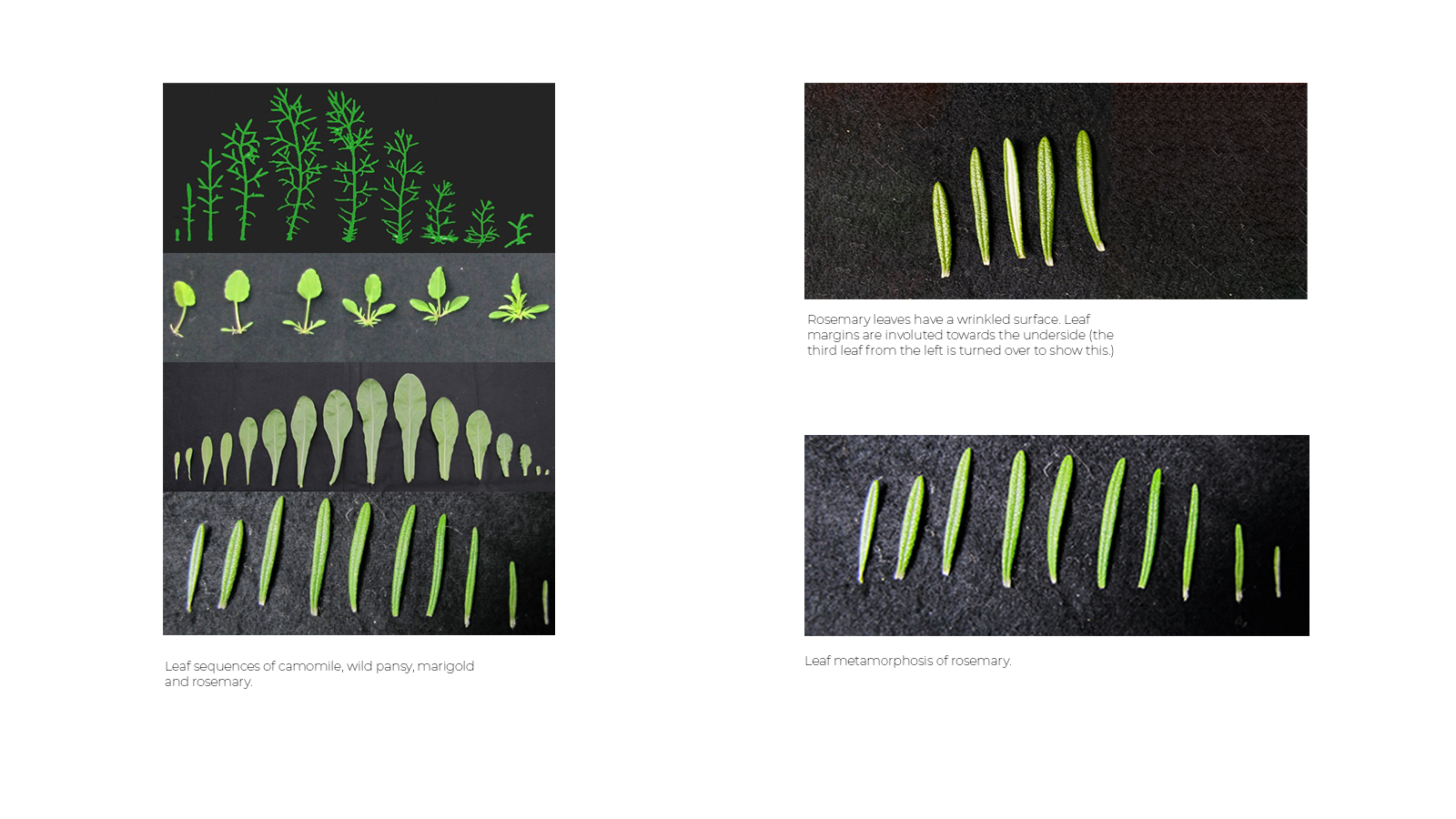
Rosemary is a well known spice and medicinal plant that can grow into a robust shrub. Rosemary leaves have a characteristic, intense, and enlivening scent. The leaf shape is reduced: leaf margins are involuted towards the underside, and the leaves give an impression of being stalks. The formative movement of elongation is prevalent in rosemary leaves. This is the expression of impulse-giving vitality – what we perceive when a plant sprouts from the soil. Each leaf sequence shows only one of the four formative movements. Contemplated together they complement each other and form a new complete whole.
Cosmetic properties and leaf metamorphosis
The effects of the four Skin Food plants are well-researched and very diverse. We present here the most important ones and relate them qualitatively to leaf metamorphosis. Our aim is to experience the qualities of the leaf metamorphoses inwardly and to bring them into a relationship with the effects on the skin. Marigold extracts are intensely nourishing for dry and sensitive skin, calming it. They can regenerate rough, cracked areas, promote wound healing, and support the formation of new skin tissue. Similarly, in the marigold leaf sequence, we experience mainly rebuilding and vitalising forces.
Camomile extracts soothe the skin. The pointing of camomile leaves is qualitatively the last stage of leaf formation preceding the appearance of the flower and the coming to rest of plant development. Dissolution and termination are the dominant processes in the leaf sequence of camomile and lead to a leaf form that looks like nerve fibres. In the same way that we experience relaxation by smelling the calming scent of camomile, the delicate leaves also have a relaxing effect. Wild pansy is a well established ingredient in cosmetics. Its extracts are rich in mucilage and act positively on impure and dry skin. It is remarkable because, in this way, wild pansy balances extremes and promotes the formation of the skin itself. In the leaf metamorphosis of wild pansy, the opposite formative movements of spreading and pointing unite in distinctive structuring and create an expressive form. Rosemary stimulates blood circulation and promotes skin metabolism. Elongation appears at the very beginning of the leaf metamorphosis and is the only formative movement in rosemary. This elongation corresponds to a tendency for giving impulses. These brief descriptions give an impression of how we can experience the qualitative correspondence between the effect of medicinal plants on the skin and their leaf metamorphosis.
A meaningful sequence leads to holistic effects on the skin
Through studying the leaf metamorphoses of the four Skin Food plants and making sense of their effects within the natural order of their metamorphoses, we can see that the composition of the medicinal plants extracts used in Skin Food might promote four essential processes of the skin which result in an overall effect:
• Giving impulses
• Regeneration
• Formation of identity
• Calming
Through the combination of the four medicinal plants, each representing one of the four formative movements of leaf metamorphoses, all four formative movements are brought into effectiveness and a new whole is created. In this way, the combination of the individual effects of the four medicinal plants in Skin Food leads to a healthpromoting new wholeness for the skin.
References:
1 Jochen Bockemühl, Leitfaden zur Heilpflanzenerkenntnis, Verlag am Goetheanum, 1996.

Torsten Arncken
Forschungsinstitut am Goetheanum, Dornach, Switzerland, www.science.goetheanum.org

Katarzyna Hänni-Ciunel
R&D NOC Actives Development, Weleda AG,
Arles heim, Switzerland,
www.weleda.com