
Sunscreens’ environmental impact is composition dependent. The bioaccumulation of UV filters in the aquatic food chain and known harmful effects on aquatic organisms makes ingredient selection critical when designing a new product.
The objective of this work was to evaluate the aquatic toxicity of several mineral filters selected according to their chemical composition (titanium dioxide, zinc oxide), particle size (lower and higher than 100nm) and combinations (titanium dioxide, silica and zinc oxide or iron oxides UT, US, UTM) that allow improved functionalities as efficiency or color. For it, we performed the luminescent bacteria test and the Artemia sp. nauplii immobilization test. Mineral filters were characterized using SEM-EDX (particles’ size, shape and composition) and ICP-MS (dissolution in seawater). Toxicity results were: EHMC >> nano-ZnO > ZnO > TiO2 > US > UTM ≥ UT. The chemical filter EHMC was the most toxic. The higher toxicity of nano zinc oxide compared to ZnO filter (>100nm) was related to the release of Zn into the aquatic environment. The combinations US, UT, UTM (particle size > 100 nm), with less impact on marine life, can be used for the development of safer and sustainable cosmetic formulations for suncare, skincare and color.
Introduction
Sunscreen mitigates the adverse effects of the sun- including erythema, wrinkles, photoaging, pigment darkening and DNA damage. Healthcare is compatible with environmental protection. Ingredients selection impacts the entire life cycle of cosmetic products- including their design, manufacture, use, ultimate disposal and the release into the environment. The bioaccumulation of UV filters in the aquatic food chain and harmful effects on aquatic organisms has been described1,2 and several chemical UV filters banned, mainly in wildlife areas.
The development of safer and more eco-friendly sunscreens is possible, with globally-approved mineral filters (zinc oxide and titanium dioxide). Combining mineral filters allows for broad UV spectrum protection (from UVB and UVA radiations), with no penetration into the skin. Besides, visible light induced pigmentation can be minimized by using sunscreen containing iron oxides3,4. UV and Vis light affects differently depending on the skin phototype. The use of mineral filters and pigments that combine titanium dioxide or iron oxides to protect from UV-Vis-IR radiation, with an average size higher than 100nm, has been described.5 In this context, we present the evaluation of the ecotoxicity of mineral filters as a function of particle size, chemical composition and combinations and their comparison with a chemical filter as a reference.
Filters characterization
The following mineral filters were chosen: ZnO (zinc oxide), nano-ZnO (zinc oxide), TiO2 (titanium dioxide), US (Zinc Oxide, Titanium Dioxide, Silica), UT (Titanium Dioxide, Silica), UTM (Titanium Dioxide, CI-77492, Silica, CI-77491, CI-77499). The particle size distribution and composition were confirmed by Scanning Electron Microscopy coupled with Energy Dispersive X-ray (SEM-EDX). Results included in table I.
Inductively Coupled Plasma Mass Spectrometry (ICP-MS) was used to assess particle’s dissolution in seawater. Ti and Fe solubility was negligible. Zn dissolution increased over time and was related to particle size: after 72h, the higher concentration was 590µg/L of nano-ZnO, followed by 338µg/L of ZnO and 326µg/L of US. The larger particle size and composition of US (zinc oxide with titanium dioxide and silica) may be related to lower zinc solubility.
Ecotoxicity evaluation
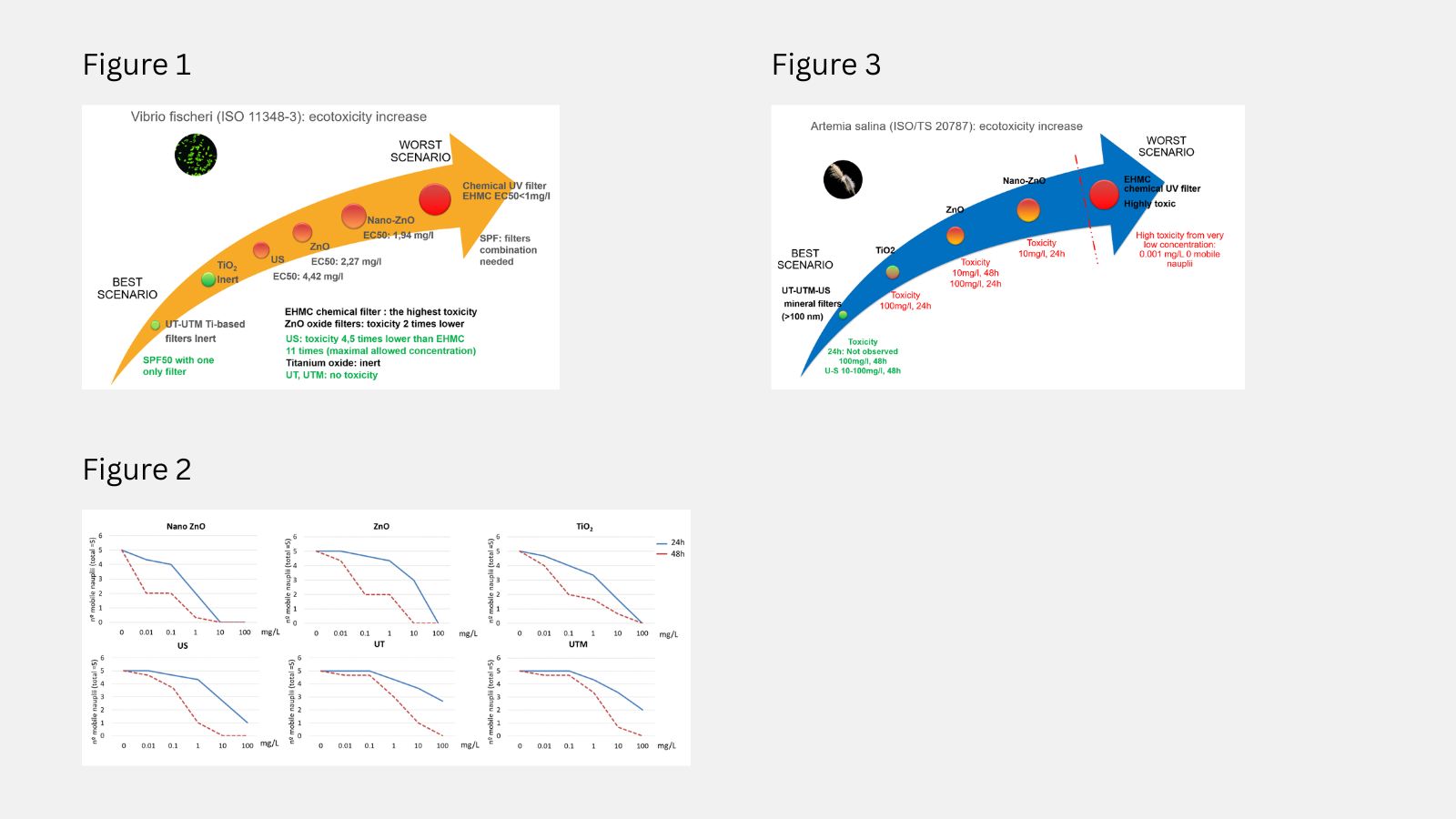
Species at different levels of organization were considered. First, the inhibition of the luminescence emitted by the marine bacterium Vibrio fischeri was determined, following ISO 11348-3:2007 (up to 30 min). Toxicity causes a decrease in the bioluminescence that is compared to a negative control to measure the lethality. EHMC was the most toxic UV filter for Vibrio fischeri: the effective concentration (EC) causing 50% inhibition was EC50 = 0.98 mg/L. Mineral filters containing zinc oxide showed lower toxicity, ordered from highest to lowest effect: nano-ZnO (EC50 = 1.936 mg/L), ZnO (EC50 = 2.268 mg/L) and US (EC50=4.426 mg/L). This toxicity decreases with increasing particle size (nano ZNO< ZnO<US) and with decreasing zinc solubility. The US filter, with a high zinc oxide content in its composition, showed toxicity 4.5 times lower than the chemical filter, calculated from the ratio between the EC50 values.
This can be explained by a combination of lower Zn solubility (222μg/L after 0.25h), larger particle size (higher than 100nm) and the combination (interaction) with titanium dioxide (shown by SEM-EDX). Additionally, US filter allows SPF50 and broad-spectrum protection with 15wt% concentration in formula, without no additional ingredients. If the maximum permitted concentrations are compared (25wt% vs. 10wt%) and a correction factor is applied, the US filter becomes 11 times less toxic. Titanium based mineral filters showed no toxicity: TiO2 (Titanium Dioxide), UT (Titanium Dioxide, Silica), UTM (Titanium Dioxide, CI-77492, Silica, CI-77491, CI-77499) filters. Ti-Fe solubility was negligible. The influence of the chemical composition is evident. See figure 1.
The second ecotoxicity study was performed on brine shrimp Artemia sp. Nauplii (ISO/TS 20787:2017, up to 48h, 5 test concentrations, 3 replicates). EHMC was the most toxic UV filter, reducing shrimp motility at all tested concentrations, from 0.001 to 100 mg/L, at 24 and 48h. When exposed to inorganic filters, toxicity was much lower. Marked effects (0 mobile nauplii) were observed in the following scenarios (figure 2), ordered from highest to lowest effect: nano-ZnO at 10-100mg/L (after 24 and 48h); ZnO at 10mg/L (after 48h) and 100mg/L (after 24 and 48h); TiO2 at 10-100mg/L (after 48h). Lower toxicological effect was observed for US at 10- 100mg/L (after 48h while 1 mobile nauplii after 24h), UT and UTM at 100mg/L (48h while 2–3 1 mobile nauplii after 24h). Besides, when looking at the beginning of the graphs it is observed that US, UT and UTM mineral filters need higher concentration to start showing toxic effect.
EHMC is toxic at a concentration 105-106 times lower than the concentration of mineral filters. Among the mineral UV filters, the toxicity to Artemia sp. nauplii depends on time and concentration, chemical composition and particle size (figure 3). Higher effects were observed for zinc oxide, more pronounced if nanometric.
Following in decreasing order, titanium dioxide showed somewhat higher toxicity than US. The explanation could be found on the larger particle size of US vs. titanium dioxide (the release of zinc or titanium is not sufficient here to justify toxicity differences). Besides, the combination of titanium oxide and zinc oxide in US structure seems to contribute to lower toxicity. Finally, UT (Titanium Dioxide, Silica) and UTM (Titanium Dioxide, CI-77492, Silica, CI-77491, CI-77499) were the least toxic UV filters. This could be explained by no remarkable Ti (and Fe) solubility and particles higher than 100nm in size. Also, note the U series concentration would not occur in the ocean.
Conclusions
All mineral filters evaluated, regardless of their composition, are less toxic than the chemical filter EHMC. Nano-sized zinc oxide filter was found to be more toxic than non-nano-sized ZnO filter and released higher Zn concentration into the aquatic environment. Taken together, results indicated that toxicity of organic and inorganic UV filters is as follows: EHMC >> nano-ZnO > ZnO > TiO2 > enhanceU-S, US > enhanceU-T-medium, UTM ≥ enhanceU-T, UT. enhanceU range mineral filters here studied (with particle size greater than 100 nm) make it possible to reduce the impact of sunscreen ingredients in the marine environment.
These multifunctional ingredients and their combinations are proposed for the development of more sustainable cosmetic formulations for the protection of all skin phototypes. Additionally, enhanceU filters are ECOCERT-COSMOS certified, 100% of Natural origin content (ISO 16128), FDA registered and fabricated by ADPCosmetics according to GMP, ISO 9001 and ISO 22716.
References:
1 Downs CA, Kramarsky-Winter E, et al (2016) Toxicopathological Effects of the Sunscreen UV Filter, Oxybenzone (Benzophenone-3), on Coral Planulae and Cultured Primary Cells and Its Environmental Contamination in Hawaii and the U.S. Virgin Islands. Arch Environ Contam Toxicol. 2016 Feb;70(2):265-88.
2 Shinn H, United States. National Oceanic and Atmospheric Administration. Office of Oceanic and Atmospheric Research; NOAA Central Library; United States, National Oceanic and Atmospheric Administration; Coral Reef Conservation Program (U.S.); (2019) The Effects of Ultraviolet Filters and Sunscreen on Corals and Aquatic Ecosystems. NCRL subject guide 2019-11.
3 Bernstein EF, Sarkas HW, et al (2021) Iron oxides in novel skin care formulation attenuate blue light for enhanced protection against skin damage. J Cosmet Dermatol 20:532–537.
4 Lyons AB, Trullas C, et al (2021) Photoprotection beyond ultraviolet radiation: A review of tinted sunscreens. J Am Acad Dermatol 84:1393-1397.
5 Motos-Pérez B (2022) Average-size minerals for UV, Vis & IR protection. Personal Care 2022-January: 16-18.
Blanca Motos-Pérez; Irene Zaldívar
Advanced Dispersed Particles S.L., ADPCosmetics, Spain,
www.adpcosmetics.com
Vanesa Benito; Alberto Katsumiti; Felipe Goñi de Cerio
GAIKER Technology Centre, Basque Research and Technology Alliance (BRTA), Spain, www.gaiker.es