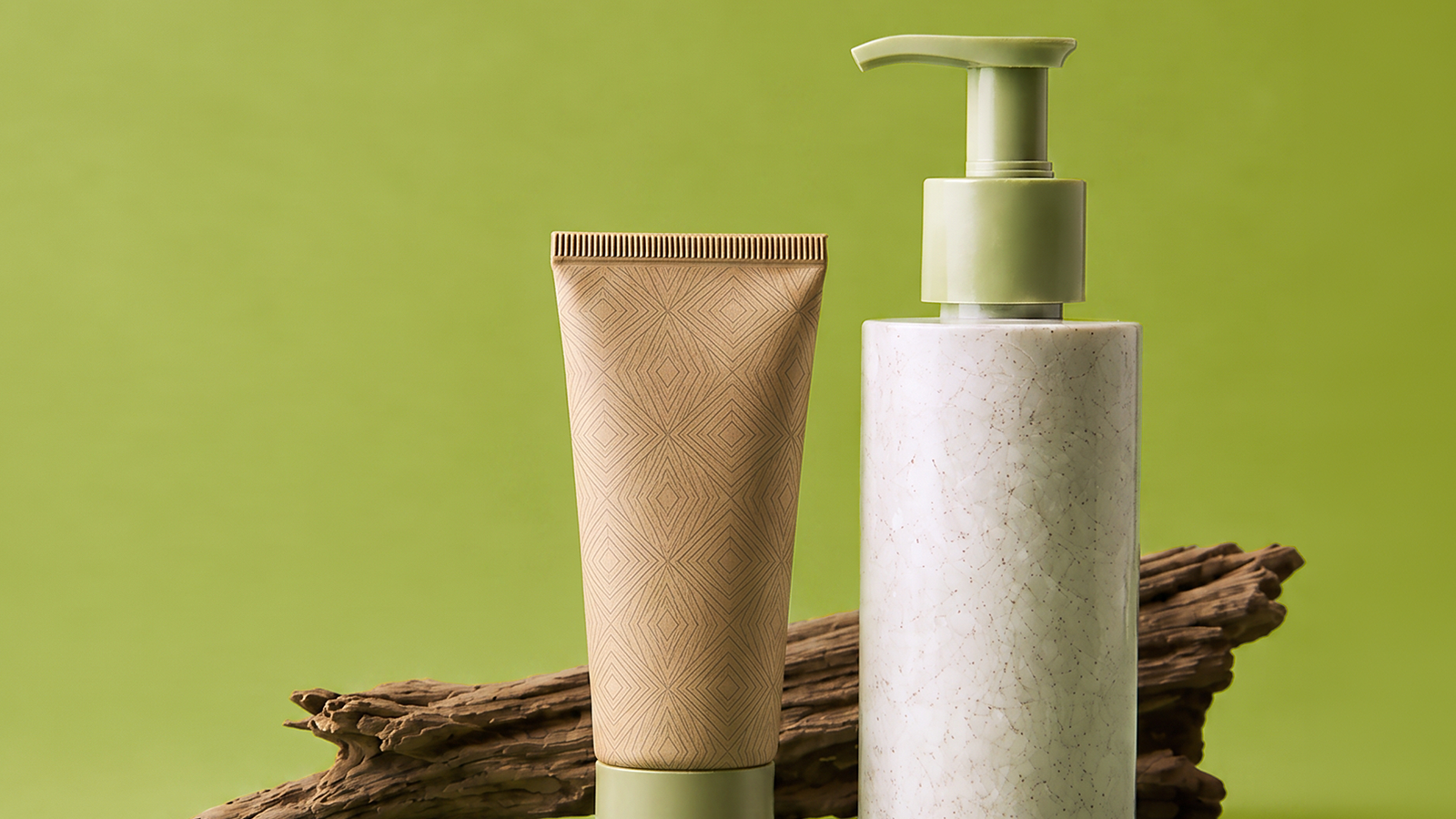
Innovation in cosmetic packaging is no longer driven solely by design or functionality, but increasingly involves the choice of materials. Growing attention toward reducing the use of fossil resources has accelerated the research into bio-based solutions. However, the real challenge for the industry does not simply lie in replacing conventional plastic with a material derived from renewable sources. A new material must meet the same requirements demanded by the market: processability, consistency, aesthetic quality, compatibility with production lines, and stable mechanical performance.
Within this context, “Rekrill”, a patented material developed by Krillmat, represents an innovative approach aimed at transforming by-products from the agri-food industry into compounds for industrial applications, including cosmetic packaging. Hazelnut shells, citrus peels, and grape pomace are not merely alternative raw materials, but become the foundation for the development of engineered materials designed to combine biomass valorization with the requirements of the manufacturing industry.
The value of this approach lies precisely in the ability to transform a naturally heterogeneous resource into a material with repeatable characteristics. Biomass, in fact, presents intrinsic variability linked to its origin, seasonality, and the specific characteristics of the by-product. For this reason, the development of a bio-based compound requires careful formulation design and rigorous control of process parameters. The selection and treatment of raw materials, particle size standardization, moisture control, and compounding optimization are essential steps to ensure consistency between different production batches and guarantee stable performance over time.
R&D: Engineering Bio-Based Materials for Industrial Applications
Research and development play a central role in this process. Each formulation is designed starting from the final application requirements and validated through a pathway that integrates mechanical, thermal, and rheological characterization with industrial-scale processability assessments. The objective is not simply to obtain a bio-based material, but to develop an engineered compound compatible with widely adopted processing technologies, such as injection molding and extrusion, avoiding modifications to existing production processes and facilitating large-scale adoption.
The development of “Rekrill” formulations follows an application-driven approach: each new grade is designed according to specific performance targets, including mechanical properties – such as stiffness, toughness, and impact resistance – as well as rheological behavior, melt stability, processing window, and aesthetic requirements.
Each formulation undergoes a comprehensive characterization program aimed at defining its Technical Data Sheet (TDS). The assessment includes thermal analyses (DSC, TGA and, when required, HDT/Vicat), mechanical testing, rheological evaluations (MFI/MFR), and characterization of the natural component through particle size distribution analysis (PSD) and, in the case of fibrous components, Fiber Analyzer evaluation. Monitoring parameters such as moisture content, particle size distribution, and compounding conditions ensures batch-to-batch consistency and maintains stable material performance over time.
For beauty and makeup applications, aesthetic performance represents a primary design parameter. Beyond functional properties, color, uniformity, surface finish, dispersion homogeneity, and long-term color stability are carefully evaluated, including aging tests when required. The control of the material microstructure is therefore essential to ensure visual repeatability and aesthetic consistency between production batches, key factors in the perception of quality in cosmetic packaging.
Cosmetic Packaging Applications
Cosmetic packaging introduces an additional level of complexity. Beyond functionality and durability, packaging plays a decisive role in shaping product perception. Aesthetics are no longer an accessory element, but a technical performance factor comparable to mechanical strength or dimensional stability.
The evolution of these materials is confirmed by industrial applications. The “XOCO” project, developed with Berlin Packaging Beauty, demonstrates how a polypropylene-based compound incorporating plant-based filler derived from hazelnut shells can be used to manufacture cosmetic packaging components without modifying molds or processing parameters. The material maintains the performance required for precision applications while giving the packaging a natural texture.
A second example is “Memora”, developed together with Lumson and Politecnico di Milano. In this case, the material becomes part of a broader vision of circularity that integrates design, refill systems, and digital tools to guide consumers throughout the entire packaging lifecycle.
The experience gained in developing bio-based materials shows that the future of cosmetic packaging will not depend solely on the introduction of new raw materials, but on the ability to transform them into industrially-reliable, repeatable solutions compatible with the production requirements of the sector.

Michela Petrillo
Marketing & Communication Manager, Krillmat,
Paderno Dugnano, Italy, www.rekrill.bio