
Gen Z are the next generation of consumers who are reshaping the beauty industry with their unique preferences and values. It is important to explore and understand their attitudes towards suncare and the growing demand for mineral UV filters. It is also important for us at Croda to look at what the formulation challenges are when developing suncare products but also to seek and advise on solutions with science backed data.
Gen Z prioritizes skincare and sun protection as part of their daily routine. They are proactive in preventing skin damage and premature aging caused by UV radiation. Social media platforms influence their perceptions of beauty care, driving more awareness of UV damage and hence more interest in suncare products. For example, 74% of UK Gen Z consumers are concerned about skin ageing and therefore use sun protection products.1 They seek products that align with their values of sustainability, transparency, and effectiveness.
Shift Towards Mineral UV Filters
Gen Z’s preference for clean beauty and natural/sustainable ingredients has increased the demand for mineral sunscreens. This can be seen in the data below, the data shows there is an increase of mineral only suncare launches between 2018 to 2024 with North America followed by Europe being the biggest contributors.It is also important to look at the suncare market globally and which countries are contributing to the biggest growth in suncare. The global suncare market is predicted to grow by 4.4 % CAGR by 2027, with China contributing to the biggest growth.
Reasons for the growth:
- Increased awareness of the harmful effects of UV rays has led to a higher demand for sun protection products. The rising popularity of clean beauty trends has led to more mineral only product launches each year.
- Mineral UV filters (Titanium Dioxide and Zinc Oxide) provide effective sun protection and can offer broad-spectrum protection without harmful chemicals. They are also perceived as gentle and mild, making them suitable for sensitive skin, this aligns with Gen Z’s preference for holistic skin.
- Both TiO2 and ZnO are globally approved at levels up to 25% and are photostable, making it easier for formulators to develop global suncare formulations.
Suncare Trends
When trying to understand the suncare market it is crucial to understand what the trends are and how brands can develop on-trend innovative suncare formulations.When you look at the claims within the UK three main claims are on the increase when comparing claims over several years, these are products for all skin tones, all natural products and ethical-upcycled ingredients. Skinification and Sunification, disruptive natural and suncare for all are popular trends. Skinification can be summarized as suncare products with an added skincare claim, we are starting to skincare focused innovation helping consumers even out skin tone, minimize break outs and protect skin against UV radiation. Sunification can be summarized as beauty products with an added suncare claims. The medicalization of beauty is leading to more demand for claims backed up with scientific data, creating value through ingredient led products. Skincare and color cosmetics products are using SPF claims to add credibility to their anti-aging claims. Both skinification and sunification trends are leading to more hybrids in the marketplace.The second trend observed is disruptive natural as eco claims are becoming the norm, there is more focus and an increase in usage of mineral UV filters as they are perceived as safer and more sustainable for the environment. There is also more focus from brands to minimize plastic waste and to use upcycled products. At Croda we have many upcycled products that range from ingredients sourced from the food, jewelry, forest and agricultural waste streams. These also have good compatibility with mineral UV filtersThe third trend is suncare for all, this is a very important trend as we are seeing more and more suncare products entering the market claiming suitability for all skin tones. There are now more claims being observed which do not leave a white cast on the skin but also can help to minimize hyperpigmentation. We have smaller particle sizes of Titanium Dioxide and Zinc Oxide which result in more transparent suncare products, making them suitable for a vast range of skincare products.
Figure 3 shows SPF use is low amongst non-white consumers and this is linked by 33 % of Black/African Americans wishing there were more options for their skin tone.
Challenges and Opportunities
Despite the growing demand and benefits for mineral UV filters, challenges exist such as white cast, and sensory.3 While mineral UV filters offer many benefits, including broad-spectrum protection and suitability for sensitive skin, they also present challenges for formulators to overcome. Innovative formulation strategies are needed to overcome these challenges and optimize the performance of mineral UV filters. Formulators must prioritize innovation to create mineral sunscreens with lightweight textures and no white cast. Leveraging influencer marketing and social media platforms can amplify brand visibility and engage Gen Z consumers effectively.
White Cast
One of the primary challenges is the white cast that mineral UV filters can leave on the skin, particularly in higher concentrations. Formulators need to formulate suncare products with mineral filters in a way that minimizes this white cast, ensuring a more natural and aesthetically pleasing appearance on various skin tones. One strategy is looking at the mineral UV filter particles in more detail, so having a good understanding about the impacts of particle size, coating and surface treatment is crucial to help to use the correct products. A way to reduce white cast is to minimize the particle size of mineral UV filters being used. Croda has a range of mineral UV filters, some contain hydrophobic coatings (e.g., silanes, stearic acid) or have been surface treated (e.g., silica, alumina. Surface treatment techniques of TiO2 particles with inert materials like silica or alumina, can further improve dispersion and reduce the perception of heaviness or chalkiness.4The mineral UV filters with the smallest particle size, enable the mineral UV filters to disperse more evenly onto the skin, this results in good transparency.Another strategy to minimize the white cast is to develop a tinted product using one of our products with the biggest TiO2 particle size. Iron oxides or effect pigments can remove the white cast effect and provide a more cosmetically acceptable finish, especially for diverse skin tones. The larger particle size allows for a good base to build color, using iron oxides or effect pigments, a smoother and more blendable application can be achieved. The bigger particle size TiO2 products offer, SPF, UVA and blue protection.5Using powder mineral UV filters allows you to choose the carrier oil and dispersing agent which can help to reduce viscosity and reduce white cast.6Hybrid Formulations and Synergistics EffectsAnother formulation strategy worth noting is developing mineral UV filters with chemical UV filters in hybrid formulations. Combining chemical and mineral UV filters is a good option to achieve high SPF formulations. TiO2 is often used as a broadspectrum, photostable base that can be built upon with chemical filters. Using both types of UV filters in different phases of an emulsion allows for biphasal distribution of the UV filters, which can boost SPF and UVAPF. There are numerous methods of incorporating a combination of both types of UV filters into a formulation. However, the most effective method of incorporation is to use an aqueous dispersion of TiO2 alongside oil soluble organic UV filters.7Hybrid formulations can offer more flexibility in meeting the diverse consumer needs and preferences. This strategy allows formulators to create suncare products, which can enhance high SPF coverage, provide cosmetic elegance by reducing greasiness and can minimize white casts. The advantage of using both mineral and chemical UV filters is the synergistic effect caused by light scattering in combination with traditional chemical UV filters to reach high SPF values.8
Waxes:
Waxes can be used to reduce whitening in formulations, but a careful balance has to be achieved as too much wax can lead to the formulations being more white. Emollients which have dispersing abilities can also help to reduce the white cast.
Texture/ Sensory/ Aesthetic Modification:
Gen Z consumers are influenced by social media and beauty standards, they place a high emphasis on cosmetic elegance and a sensory experience when it comes to sunscreen products.Brands must invest in research and development to improve the sensory properties of mineral UV filters, making them more cosmetically elegant and enjoyable to use.This includes addressing concerns such as greasiness, tackiness, and difficulty in blending, which can deter consumers from incorporating mineral UV filters into their skincare routines. Achieving a lightweight and non-greasy texture without compromising sun protection efficacy is essential to enhance user experience and encourage regular application.Formulating mineral only high SPF sunscreens can sometimes lead to a draggy and heavy skin feel. Using complementary ingredients, such as emollients, waxes and film formers, can improve spreadability and texture while reducing greasiness and tackiness. Medium skin play emollients can help to minimize the drag associated with ZnO formulations. Certain gums can help to optimize the viscosity and texture which can help ensure a smooth application and even coverage which can lead to better SPF efficacy.
Processing (Emulsification and Stabilization):
Formulating mineral UV filters with high levels of SPF protection while maintaining stability and shelf life can be complex. To achieve high SPF mineral UV filters, it is important to use innovative emulsification and stabilization techniques.Using high shear during the emulsification process is crucial for stability and improved skin feel. Equipment such homogenizers such as Ultra Turrax and Silverson can help create stable smaller droplets which can improve stability. Incorporating structuring agents (e.g. gelling agents, clays) can enhance viscosity at 3% and stabilize emulsions, preventing phase separation and sedimentation of mineral UV filter particles.
Using SPF Boosters
Achieving high SPF can be a challenge but a formulator can use different strategies to improve SPF. Research shows that methodically building a formulation beginning with a mineral dispersion and carefully choosing other ingredients can help achieve the goal of high SPF.9Adding an additional amount of mineral UV filters may not be the most efficient way to create a high SPF, as this can impact negatively in sensorial, white cast and cost. It is important to consider the chassis optimization and the UV filters homogeneous distribution into the formulation film. It is also crucial to look at more innovative ways to achieve high SPF to ensure:
- Sensory is not impacted
- White cast is kept to a minimum
Ingredients such as waxes, emollients and emulsifiers have been shown to increase SPF. At Croda there are two new 100% natural cellulose products with two different particle sizes, which have been shown to SPF boost in mineral only and hybrid formulations. The celluloses at 3% can also help to improve sensory and help to stabilize suncare formulations.
Conclusion
Suncare trends among Gen Z indicate a growing preference for mineral-only suncare products due to their natural and eco-friendly properties. Their preferences in suncare trends reflect their values of sustainability, health, and authenticity.The influence of social media and increasing sun protection awareness contribute to the popularity of mineral-only suncare products among Gen Z and are expected to remain a staple in Gen Z’s skincare routines.By incorporating these formulation hints into product development strategies, formulators can overcome the challenges associated with mineral UV filters in suncare products formulations and deliver high-performance, cosmetically elegant suncare products that meet the evolving needs and preferences of Gen Z consumers.
|
Who are Gen Z? • Gen Z are born approximately between the mid-1990s and early 2010s, it is important to note that they represent a significant consumer demographic. • They are called digital natives and are the first generation to grow up with technology and social media as part of their daily life. • Their attitudes towards skincare and sun protection are heavily influenced by social media, sustainability concerns, and desire for authenticity. • Understanding their preferences is crucial for brands/formulators looking to stay relevant in the ever-evolving suncare market. |
|---|
Afshan Nayyir Mazhir, Aline Souza, Sophie Ruebel
Croda International Plc., www.croda.com
References:
1 Mintel, 2024
2 Ocean-safe protection in sight? Abhijit Bidaye, Applications Team Leader Scott Cardinali, Business Development, Manager, Croda, Edison, COSSMA 1–2 I 2019
3 Christian Surber, Uli Osterwalder. Challenges in Sun Protection Pages 1-44
4 Characterization of TiO2 Nanoparticles Surface Modified with Aluminum Stearate, Terry A. Egerton,*,† Neil J. Everall,‡ and Ian R. Tooley Chem. Volume 55, 2021, 12, 1111.
5 Importance of broad spectrum inorganic sunscreens in preventing UV and near-UV induced free radical damage to the skin Dr. Robert M. Sayer, Dr. Paul Staniland, Dr. Gemma L. Stansfield, Croda, Ditton, United Kingdom Cosmetic Science Technology 2013
6 Bethan Spruce, Aline Souza, Ellen Copsey. Working with TiO2 UV filters in powders form: an experimental review on how to formulate sunscreen formulations using powdered TiO2 UV filters Croda Europe, PCG May 2002
7 Bethan Spruce. Synergistic benefits of using organic and inorganic UV filters in suncare formulations
8 Lademann, J., Schanzer, S., Jacobi, U., Schaefer, H., Pflücker, F., Driller, H., Beck, J., Meinke, M., Roggan, A. and Sterry, W., 2005. Synergy effects between organic and inorganic UV filters in sunscreens. Journal of Biomedical Optics, 10(1), p.014008, Cosmetic Business 2020.
9 Building a High SPF Sunscreen Formulation with Inorganic Filters – Cheryl Seidell; EverCare, Megan Perkins; U of Toledo SCC75th Annual scientific meeting & Showcase
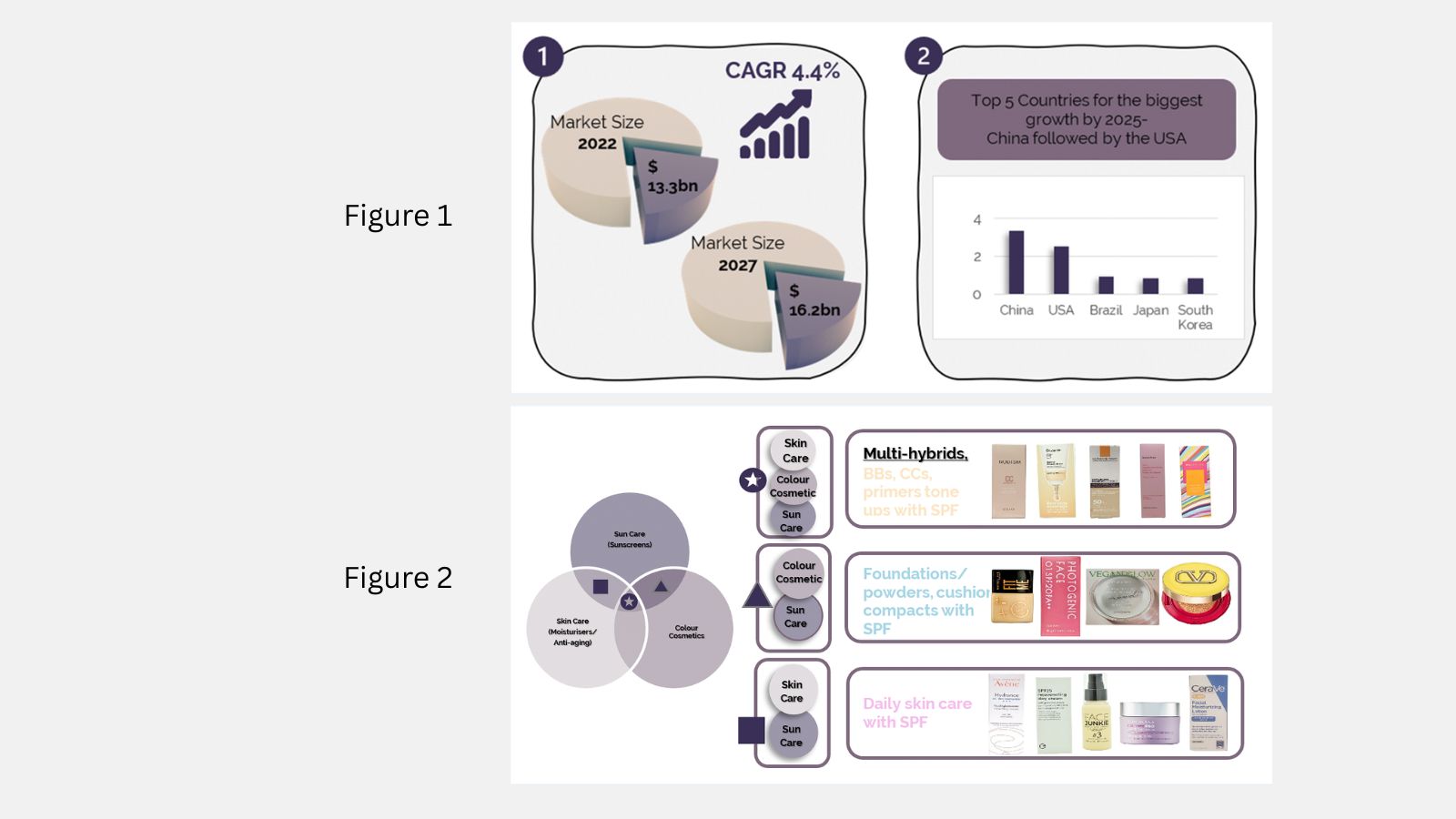
Figure 1
Data showing the growth for suncare globally and which countries show the biggest growth.
Figure 2
A diagram showing hybrid products. (Source: Mintel)
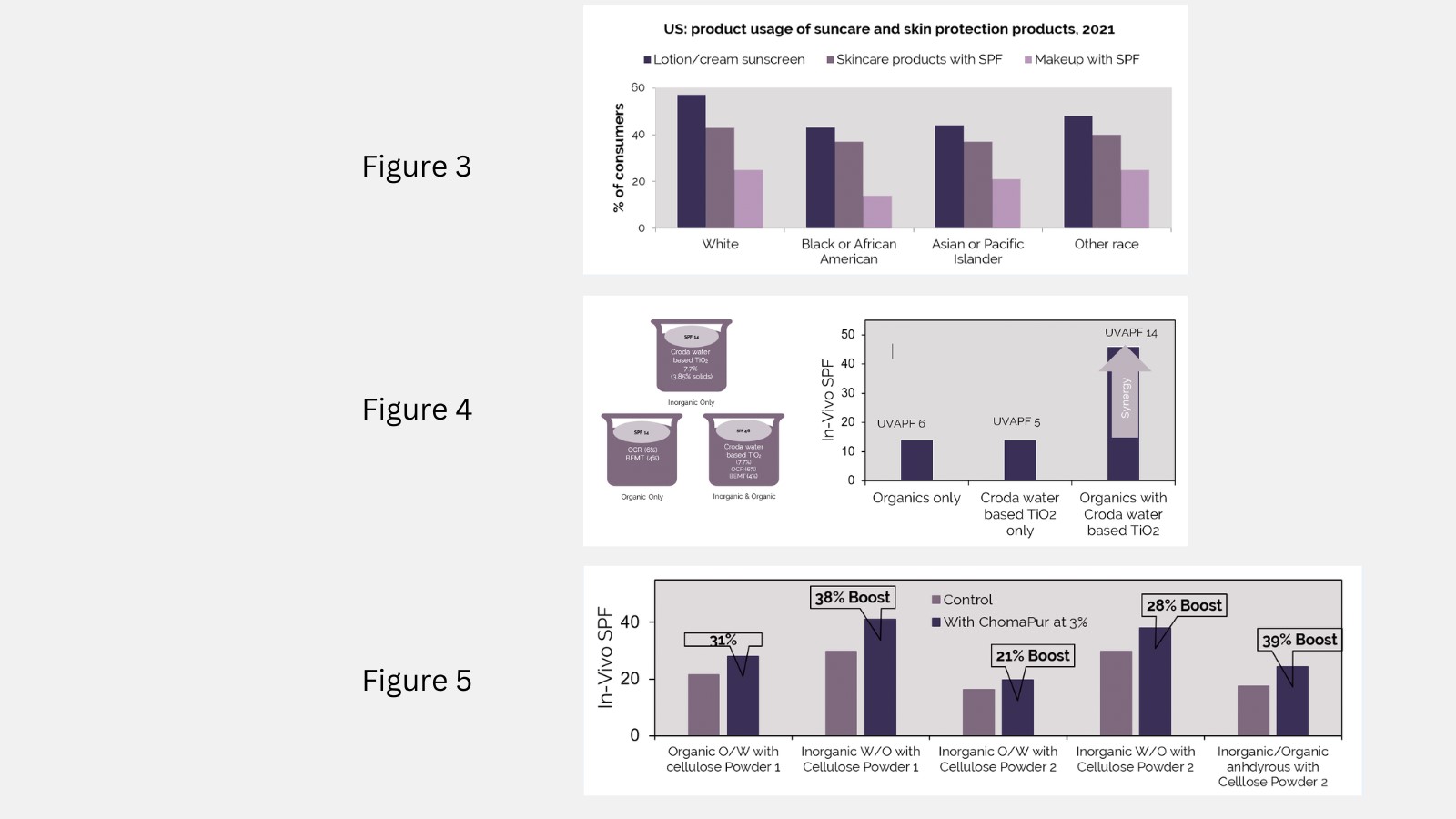
Figure 3
A graph showing usage of suncare and skincare products. (Source: Mintel)
Figure 4
Graph showing the benefits of using a water based TiO2 and organic UV filters (hybrid suncare formulation).
Figure 5
Graph showing the SPF boosting of Croda’s Cellulose Powders.