
Even if the claim “microbiome friendly” is being used more frequently in cosmetics, it has not yet been conclusively clarified which substances can influence which bacteria and fungi. Anne-Sophie Dutailly took a closer look at a few ingredients and examined their effects.
Still, skin microbiome science is in its infancy and almost no standard models exist. It is known that an imbalance in skin microbiota is associated with three major disorders: dry skin, skin itching/redness and oily skin. But it is still unclear if the microbiota unbalance would be the cause or the consequence of the skin disorders and so many side effects can appear. The only thing we can be sure of is that any modification in one targeted bacteria or mould will have an impact on the whole fragile ecosystem.
The challenge of balance
In partnership with external providers, the company set up an in vitro model aimed at studying the influence of the Cutibacterium acnes secretome on the barrier function of reconstructed epidermis. The concept was to measure the influence of an extract from a Harungana madagascariensis tree1, on the message (the secretum issued by the bacteria) and its effect on the skin without altering the messenger (C. acnes). It appeared that C. acnes secretum had a deleterious effect on skin barrier and skin cohesion that the active was able to counteract with up to 65% of protection.
As a result of this mode of action, the active ingredient has shown nice properties on volunteers as it combines soothing, antioxidant effect and offers visible imperfection reduction (-34% of whitehead, -37% of blackhead) and pore minimising for an improved skin texture perceived by 85% of the volunteers (vs 55% for benchmark). A second in vitro model made it possible to study the biofilm of Staphylococcus aureus in the presence of Staphylococcus epidermidis on reconstructed epidermis. Indeed, the pathologies associated with S. aureus range from minor infection to invasive and potentially dangerous diseases. S. aureus infection of the skin, associated with skin disorders such as atopic dermatitis, occurs in part through the development of the biofilm. In this model, it was able to demonstrate the effect of another active ingredient that is sourced at the core of Great Burdock roots2 on biofilm formation while respecting the bacterial balance. Thus, revealing new benefits on skin protection and microbiota equilibrium, support of skin-microbiota interactions, control of the microbiota biodiversity, protection of skin integrity. Furthermore, tested on volunteers with very dry and/or sensitive skin, the active targets two of the major imbalances linked to the microbiota disorder. It improved the skin’s tolerance threshold to environmental stresses by reducing both skin redness (-60%) and stinging/burning sensations (-20%) after 14 days vs placebo. For a better and long-lasting skin comfort, it also promotes skin moisturisation (+56%) after 21 days vs placebo.
Finally, a glycine and sugar biovector active3 helps to regulate the proliferation of microorganisms responsible for cutaneous disorders or bad odours while preserving bacteria beneficial to the skin. At a higher concentration, it regulates microorganisms responsible for formula contamination, thus enabling the reduction of the quantity of preservatives. Beyond the active ingredients, all the ingredients in a formulation can potentially have an impact on the microbiota.
Helpful texture ingredients
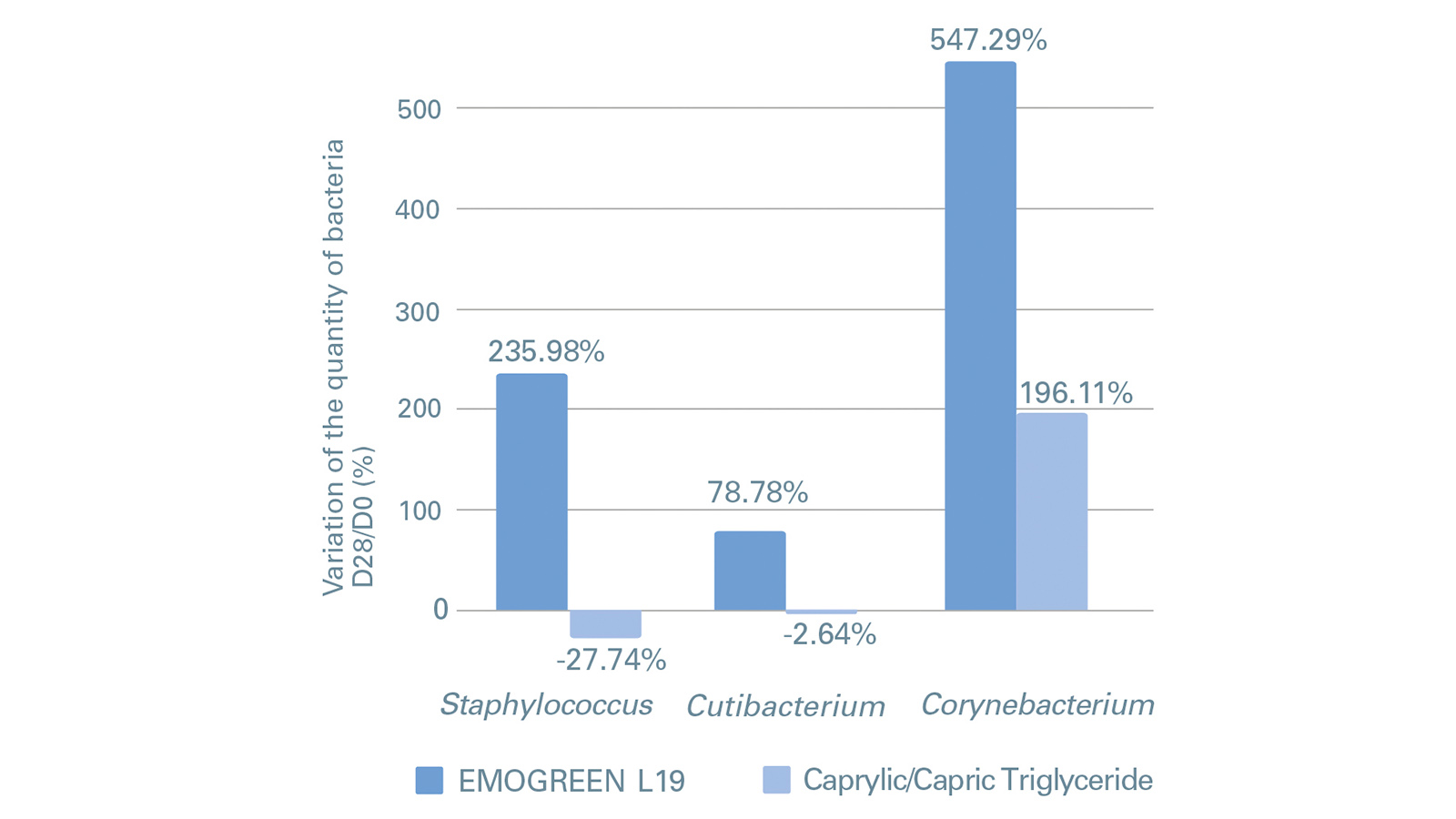
When it comes to microbiota balance, not only the active ingredients have to be considered, but also the formulation ingredients. An emollient4 was also proven to be microbiota friendly. Tested at 10% in an O/W emulsion used for 28 days in comparison to the same formula containing a classical oil (Caprylic/ Capric Triglyceride), it was able to improve the balance of very dry skin microbiota. Indeed, this non-polar oil showed a capacity to increase the population of three bacteria genus:
Corynebacterium, Cutibacterium and Staphylococcus within the skin microbiota. These three genera are known to participate in the production of the hydrolipidic film, involved in skin hydration. That’s why the increase of the three species is in favour of a reconstituted hydrolipidic film, the first step to a better skin hydration. Action on the skin “inviproliferasible barrier” was assessed thanks to the amplification of the part of the RNA representative of the skin microbiota and 16S RNA sequencing.
References:
1 Subligana
2 Equibiome
3 Fluidipure 8G
4 Emogreen L19
5 Baldwin HE, Bhatia ND, Friedman A, Eng RM, Seite S. The role of cutaneous microbiota harmony in maintaining a functional skin barrier. J Drugs Dermatol. 2017;16(1):12-18.
6 Byrd AL, Belkaid Y, Segre JA. The human skin microbiome. Nat Rev Microbiol. 2018;16(3):143-155. Cogen AL, Nizet V, Gallo RL. Skin microbiota: a source of disease or defence? Br J Dermatol. 2008;158(3):442-55.
7 Dréno B, Pécastaings S, Corvec S, Veraldi S, Khammari A, Roques C. Cutibacterium acnes (P. acnes) and acne vulgaris: a brief look at the latest updates. J Eur Acad Dermatol Venereol. 2018;32 Suppl 2:5-14.
8 Human Microbiome Project Consortium. A framework for human microbiome research. Nature. 2012a;486(7402):215-21.
9 Lafforgue Christine, Skin & Microbiota – SFC Training 2018

Anne-Sophie Dutailly,
Marketing Product Manager
Beauty care, Seppic, Paris, France,
www.seppic.com