
Sustainability | Active ingredients obtained from food production waste are on the rise. David Manzano and Clara Vigo show how an ingredient obtained from apple pomace closes the cycle of sustainability and at the same time improves skin health.
Preventing environmental im- pact before it is generated is essential to improve our planet’s complicated situation. So, prevention sits right at the top of the waste management hierarchy, and at the top of the consumers’ minds, who think of sustainability as a holistic concept where the whole value chain must be integrated to achieve a zero-waste beauty industry – an industry that truly operates in harmony with nature’s rhythms.
In the face of this needed transformation, the beauty sector is starting to take various measures such as developing sustainable products, guaranteeing a sustainable sourcing, and promoting resilience and collaboration in the supply chain, with the goal of achieving a beauty industry that truly operates in line with circular economy principles.
Taking this circular economy as a starting point, the development of so called upcycled ingredients simply involves using industry waste or by-products to give them a renewed or more highly valued purpose. In this context, the cosmetics sector can play a central and catalysing role since it is able to make use of waste and give it a much higher added value.
The best of apples
Apples are known around the world to be synonymous with health, no doubt since their consumption has many times been empirically asso- ciated with the reduced risk of some cancers, cardiovascular diseases, asthma, and diabetes5,11. Secondly, because of the apple’s known anti-ageing and whitening proper- ties, UVB protection and lipolytic activity25,29.
However, its upcycling is now a necessity. Recent data indicates
that 40% of fruit and vegetables
are thrown away every year17, and apples are one of the most widely eaten and used fruits, generating millions and millions of tonnes of food waste. Spain alone produces more than half a million tonnes of apples each year, 25-30% of which becomes waste material20.
Given the alarming numbers of apple waste production, the idea was born to further assess the cosmetic uses of apple pomace generated by a local artisan supplier1. With more than 50 years dedicated to the cultivation of apples and the production of some of its derivatives, they generate tonnes of apple pomace. This agricultural waste product is generated after apples are pressed to obtain the juice and other apple-processed derivatives. It contains a mixture of flesh, skin, and seeds, and it is rich in polyphenols33.
So, the apple pomace is given a
much higher value that would increase the profit for the primary sector, help reduce the carbon footprint, and promote an industrial
symbiosis that encouraged sustainable growth for both agricultural and beauty industries (complying like this with three of the UN Sustainable Development Goals).
Proven by studies
Thanks to three in vitro studies
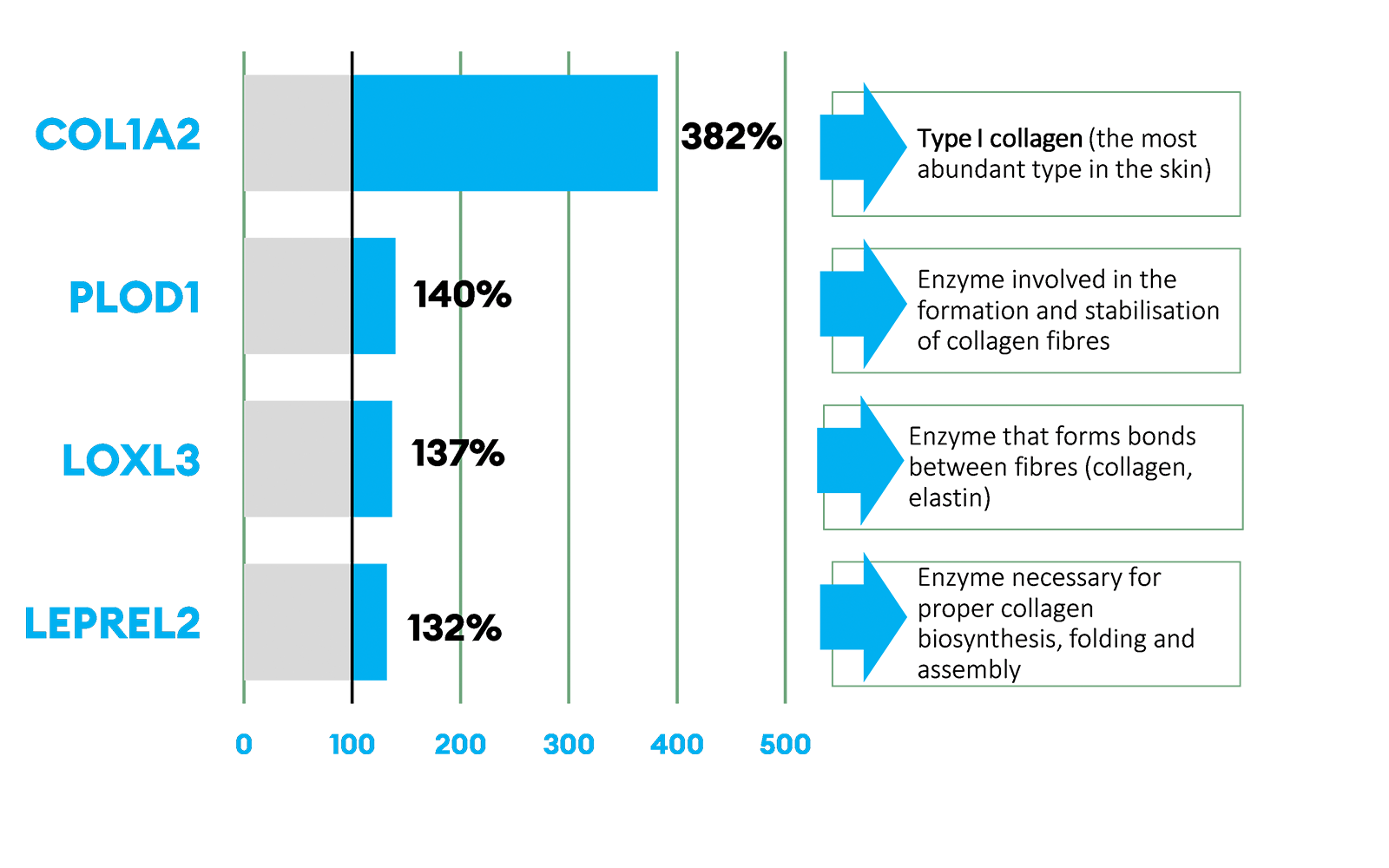
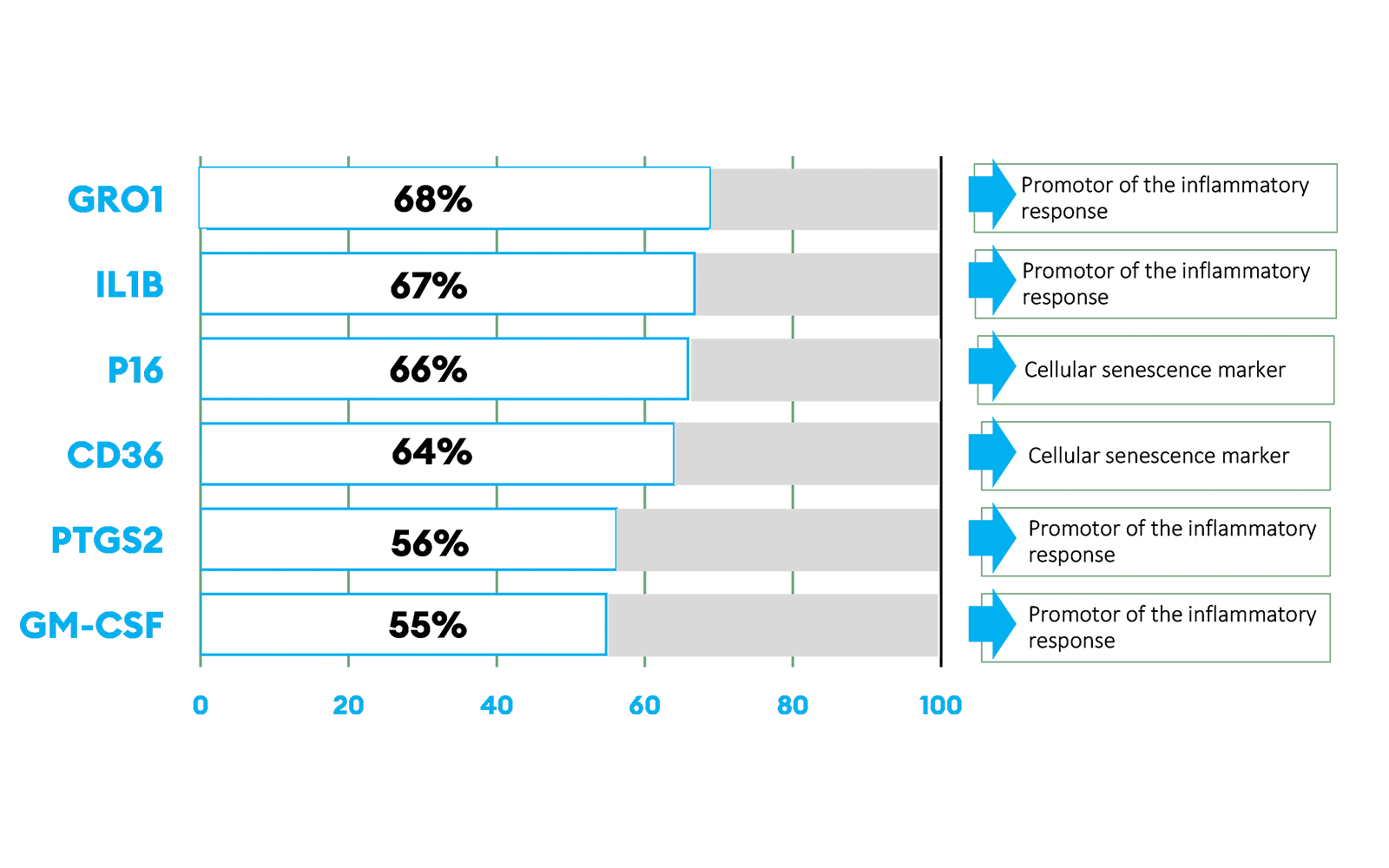
performed in both normal and aged human dermal fibroblasts, the cosmetic benefits of this polyphenol-rich material were successfully assessed. The results of these studies confirmed that the health-giving properties of apples are also reflected in the improvement of the skin’s extracellular matrix and the re-densification of the dermis, thanks to a new active ingredient’s2 action on:
Collagen biosynthesis and proper organisation (figure 1)
The reduction of inflammatory and cellular senescence processes (figure 2)
Some of the genes evaluated – such as GM-CSF, PTGS2, IL1B, GRO1, CD36 and P16 – have been described as genes involved in skin aging, as they increase with age and promote mechanisms such as collagen degradation, inflam-
mation or cellular senescence7,9. Others – such as LPREL2, LOXL3, PLOD1 and COL1A2 – are known to do precisely the opposite, that is, their expression is linked to
the biosynthesis of ECM and therefore the improvement of the skin’s structure. To be more precise, these genes are involved in processes such as collagen biosynthesis,
the formation of bonds between fibres (collagen and elastin alike) and the synthesis of other enzymes involved in the post-translational maturation of collagen and its
correct assembly outside of
the cell21,32.
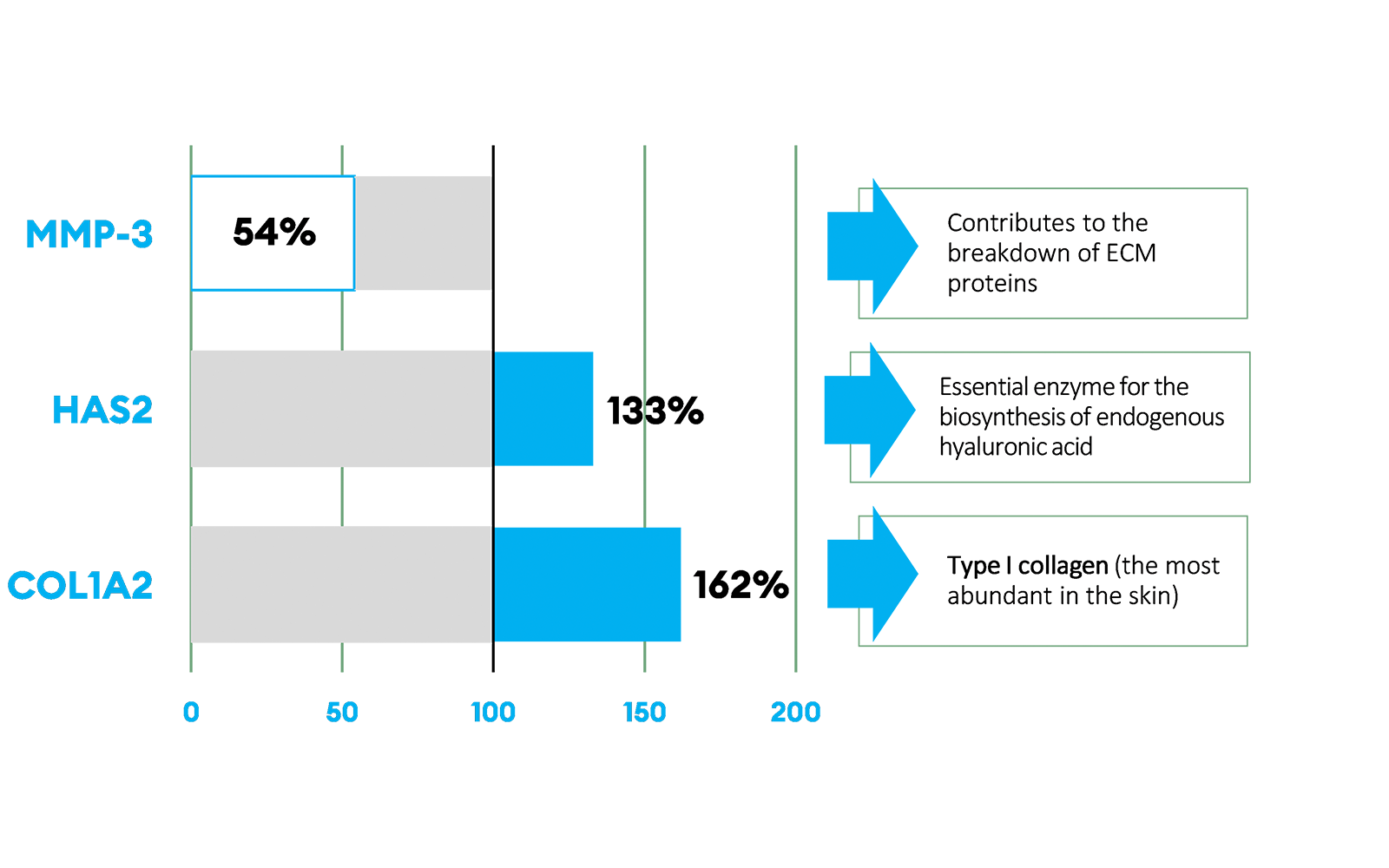
Biosynthesis of endogenous hyaluronic acid and other ECM components (figure 3)
The results showed a higher gene expression as HAS2 and COL1A2, and a lower gene expression
as MMP-3, demonstrating once again the positive effect of the active ingredient on the structure of the skin’s ECM and, therefore, on the elasticity and density of
the dermis, since the expression
of the first two is reduced in aged fibroblasts14,34.
References:
1 Mooma, located in the Empordà, in Girona (Spain), a few kilometers from Provital.
2 Pomerage; 100% natural with an upcycled and Km-0 origin.
All references and the bibliography can be found online at www.cossma.com with the webcode 100561.

David Manzano, R&D Project Manager, Provital, Barcelona, Spain, www.weareprovital.com

Clara Vigo, Product Manager, Provital, Barcelona, Spain, www.weareprovital.com