Sugar goes by the nickname of “sweet poison” – and that applies to our skin cells, too. After years of intense research, a team at Beiersdorf has cracked the code of glycation processes in the skin and identified an active ingredient that counters sugar-induced skin aging. The innovative formula, with its scientifically tested active ingredient complex, prevents new wrinkles from forming and visibly reduces existing wrinkles.
The mere sight of sugary foods and beverages sends the reward system in our brains into overdrive and fills us with all sorts of joyful anticipation. As we eat or drink, sensory receptors on our tongues broadcast positive signals to our brains – and our brains “call” back: “Give me more!” Our control centres have not misread the situation. They are simply responding to our addiction to sugars. Whenever we breathe, think, or run a marathon, sugar metabolism supplies us with the energy we need. Numerous scientific studies conducted years ago found a connection between excessive amounts of sugar consumption and various risk factors, including obesity, type 2 diabetes, hypertension, cardiovascular disease, and autoimmune diseases. But one fact has generally slipped below the radar of the general public and, occasionally, the radar of some experts as well: Sugar can also have a harmful effect on the skin – and cause wrinkles. After roughly 10 years of research, the code of glycation processes in the skin has been cracked and an innovative product that counters sugar-induced skin aging and wrinkle formation has been developed.
Glycation: “killer” of collagen fibres
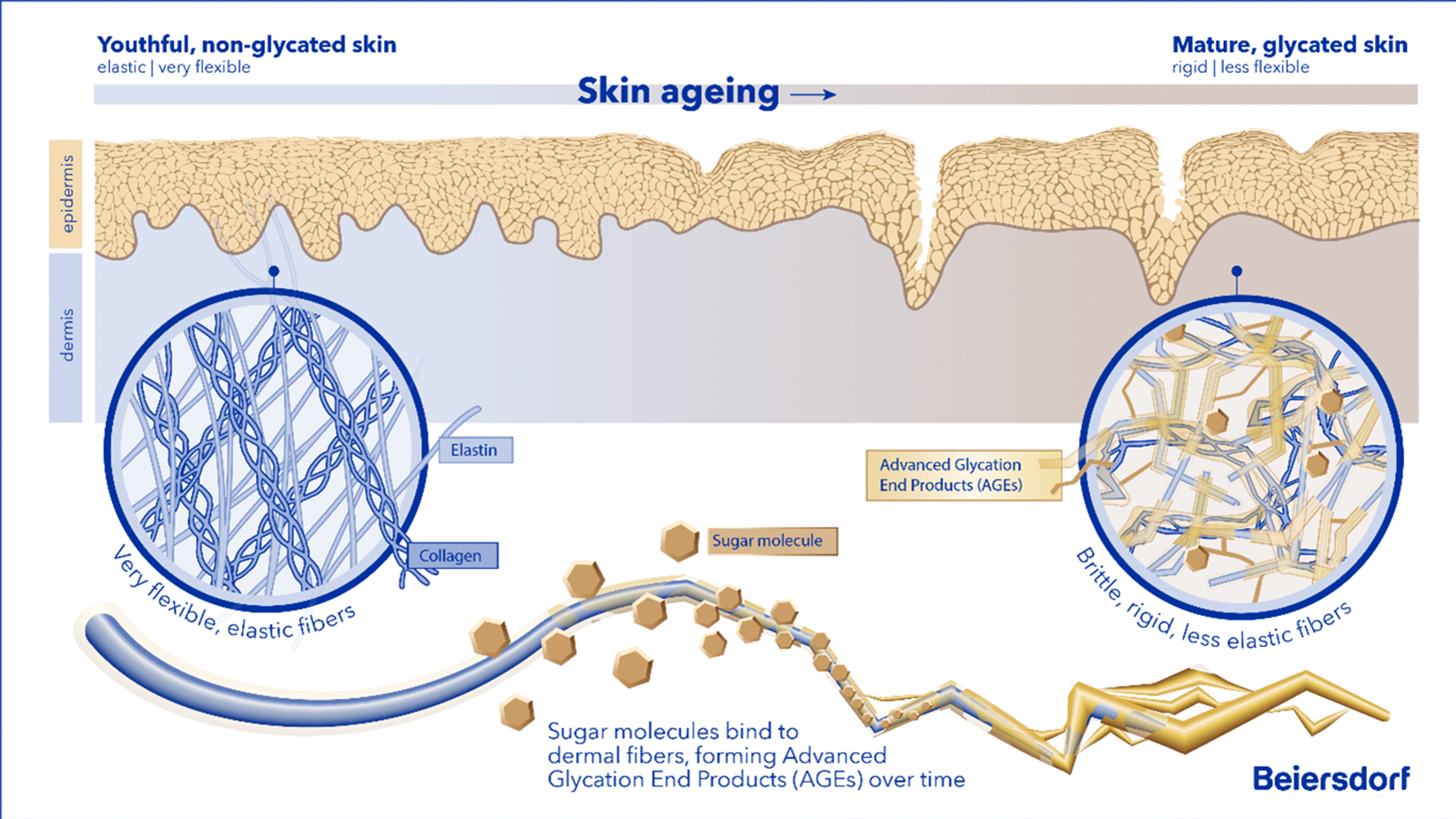
The skin is the largest organ – it is a real multi-talent. In its role as a stable but flexible shield, it protects the bodies from environmental influences like UV radiation, dehydration, cold, pathogens, and toxic substances. The supporting connective-tissue proteins collagen and elastin exhibit long-lasting stability and show very long half-life times of up to several decades in the skin. Glycation is a natural, but irreversible chemical reaction. In this process, sugar molecules bind to proteins or lipids. This promotes the formation of advanced glycation end products (or AGEs). The longer a protein’s half-life in the skin is, the more AGEs it can build up. These AGEs can then cause inflammatory reactions and trigger the formation of free radicals. In simple terms: Sugar damages and weakens collagen and elastin fibers in the skin, causing the loss of their resilience and elasticity. This is believed to be among the main causes of increased wrinkle formation in addition to UV stress. However, aged skin is not only fragile and wrinkled, but also yellowish in colour. This may be contributed to the intrinsic yellow-brown colour of several AGEs. But one thing is clear: The less glucose (dextrose), fructose (fruit sugar), lactose (milk sugar) or the typical “industrial sugar” sucrose that we consume, the bigger the favor we are doing for our skin. Eliminating sugars completely from diets is almost impossible, as we know. What’s more, the “sweet poison” plays a key role in the metabolism process of human beings.
The glycation process explained – how sugar impacts skin aging
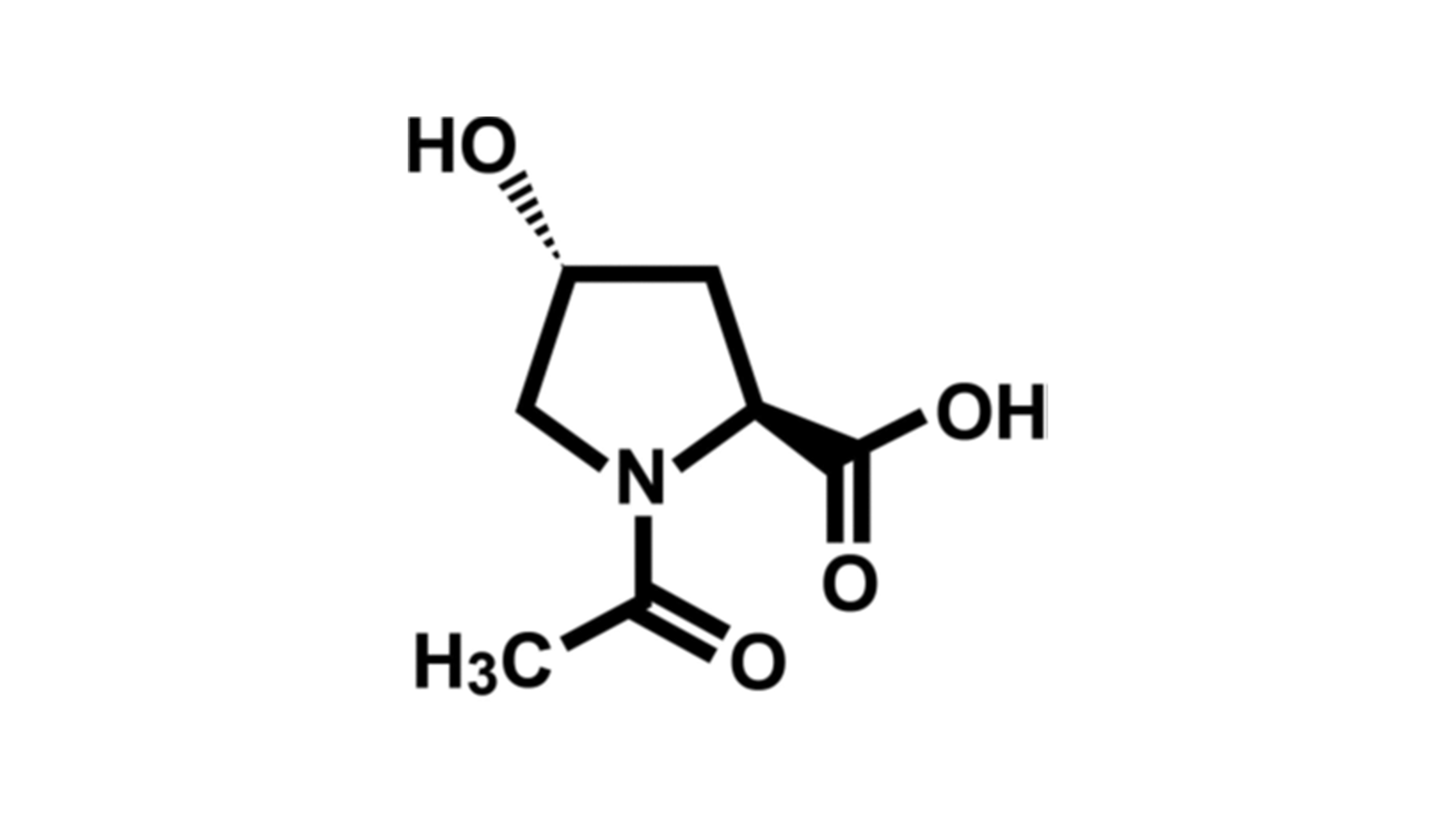
Structure of N-acetyl-L-hydroxyproline (NAHP)
Source: Knoblich et al, N-acetyl-L-hydroxyproline – A potent skin anti-ageing active preventing advanced glycation end-product formation in vitro and ex vivo. Int J Cosmet Sci. 2024 Apr;46(2):297-306. doi: 10.1111/ics.12930. Epub 2023 Nov 27. PMID: 38013225. CC BY-NC-ND 4.0
Effects of NAHP
Source of both illustrations: Knoblich et al, N-acetyl-L-hydroxyproline – A potent skin anti-ageing active preventing advanced glycation end-product formation in vitro and ex vivo. Int J Cosmet Sci. 2024 Apr;46(2):297-306. doi: 10.1111/ics.12930. Epub 2023 Nov 27. PMID: 38013225. CC BY-NC-ND 4.0
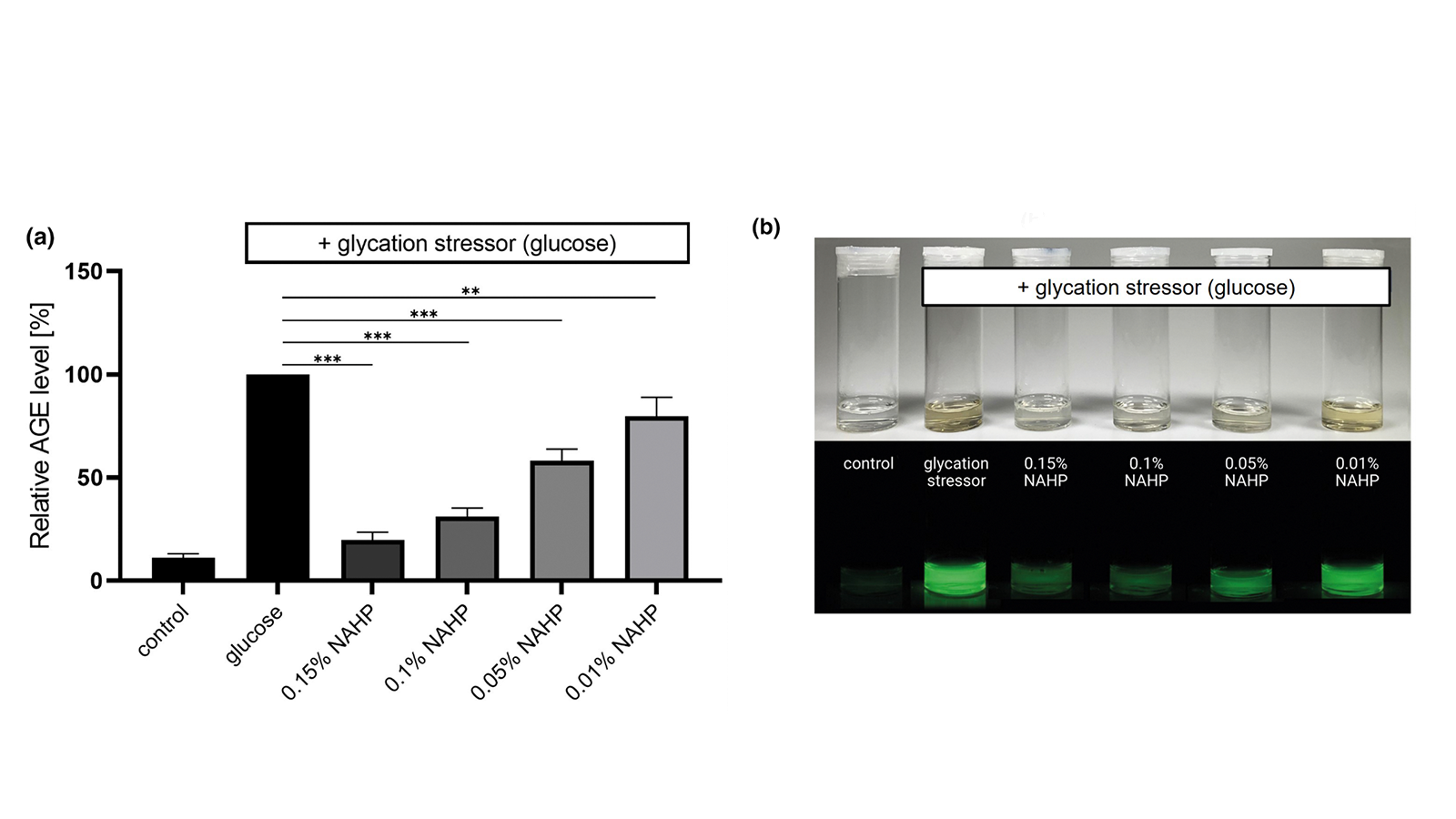
(a) Relative AGE levels in a cell-free assay after co-incubation of a BSA protein solution with the glycation stressor glucose and different concentrations of NAHP for 6 days at 50°C. A control BSA solution without glucose served as a negative control. Results are depicted as median with range. Significant differences are marked with an asterisk (N = 6, *p ≤ 0.05, **p ≤ 0.01, ***p ≤ 0.001).
(b) Visualisation of the AGE-inhibiting effect of NAHP. AGEs display a brownish appearance and show a green flourescence.
Researching the issue of skin aging
After intensively exploring the subject of glycation in human skin for a decade, new scientific findings could be revealed.1 Vimentin is said to be the specific target in skin glycation. The result: Cutaneous glycation was viewed as a non-specific reaction between reduced sugars and amino groups of random proteins. During elaborated experiments, the skin researchers identified the filament protein vimentin as one prominent target for AGE modification in primary human skin fibroblasts. Remarkably, glycation of vimentin can be attributed to its structural characteristics. Accumulation of modified vimentin in skin fibroblasts obtained from older donors was confirmed to be present in vivo as well, clearly indicating a close link between AGE modifications in human skin and the loss of the organs’ contractile functions. Additionally, the natural degradation product of glucose, methylglyoxal, was shown to induce an aggregation of vimentin. These findings highlight once again the special role of vimentin as a cellular target of the Maillard reaction in human skin2 .
The “hero” NAHP
In the years that followed, around 1,700 active ingredients have been tested for their potential to inhibit AGE formation. A clear “active ingredient winner” ultimately emerged: NAHP, the abbreviation for N-acetyl-L-hydroxyproline. This is a derivative of the amino acid proline that occurs naturally in the body. In contrast to other cosmeceutical anti-glycation actives that scavenge the sugar and thereby sacrifice themselves and are glycated, NAHP protects proteins from the saccharification reaction without getting glycated and significantly reduces the formation of AGEs. Sugar molecules are neutralised before they can bind to proteins and weaken collagens, among other things. This is why NAHP also is called ‘Glycostop’. During the protracted development work, the mechanism of action of NAHP on skin cells initially had to be explored more deeply. Based on that a formulation has been worked out and then continuously optimised.
How? Not every active ingredient can be easily integrated into creams and remain stable for months at a time. Solubility played a major role. Colour and smell were two other important issues. It had to be determined which concentration of the active ingredient would have the best effect. Before the experts could conduct tests on human skin, they used a skin model in which cells were introduced to a collagen gel – and thus simulated “real” skin. Combination of ‘Glycostop’ and the anti-wrinkle active ingredient Q10 The AGE inhibitor ‘Glycostop’ has been combined with the energiser coenzyme Q10 in an innovative formula(for example in Nivea Q10 Dual Action Serum). The two extremely potent active ingredients have a double impact: ‘Glycostop’ prevents skin aging by effectively impeding the saccharification of connective tissue proteins like collagen (tested in vitro). By increasing the Q10 level in the skin, the skin can provide more energy and is better protected from free radicals3 . The new serum works immediately and has been clinically proven to visibly reduce even the deepest wrinkles within two weeks.
References:
1 Kueper et al: „Vimentin is the specific target in skin glycation. Structural prerequisites, functional consequences, and role in skin aging.” J Biol Chem 2007 Aug 10; 282(32):23427-36. doi: 10.1074/jbc.M701586200. Epub 2007 Jun 13. https://pubmed.ncbi.nlm.nih.gov/17567584/
2 Kueper et al: „Modification of vimentin: a general mechanism of nonenzymatic glycation in human skin.” Ann N Y Acad Sci. 2008 Apr:1126:328-32. doi: 10.1196/annals.1433.039. https://pubmed.ncbi.nlm.nih.gov/18448838/
3 Knott et al: "Topical treatment with coenzyme Q10-containing formulas improves skin’s Q10 level and provides antioxidative effects". Biofactors. 2015 Nov-Dec;41(6):383-90. doi: 10.1002/biof.1239. Epub 2015 Dec 9.
https://pubmed.ncbi.nlm.nih.gov/26648450/

Gunnar von der Geest
Freelance Journalist, specialising in research and development and corporat brand history, Hamburg, Germany

Dr Thomas Blatt
Principal Scientist for Skin Biology at Beiersdorf

Dr Julia Weise
Laboratory Manager for Biological Testing at Beiersdorf