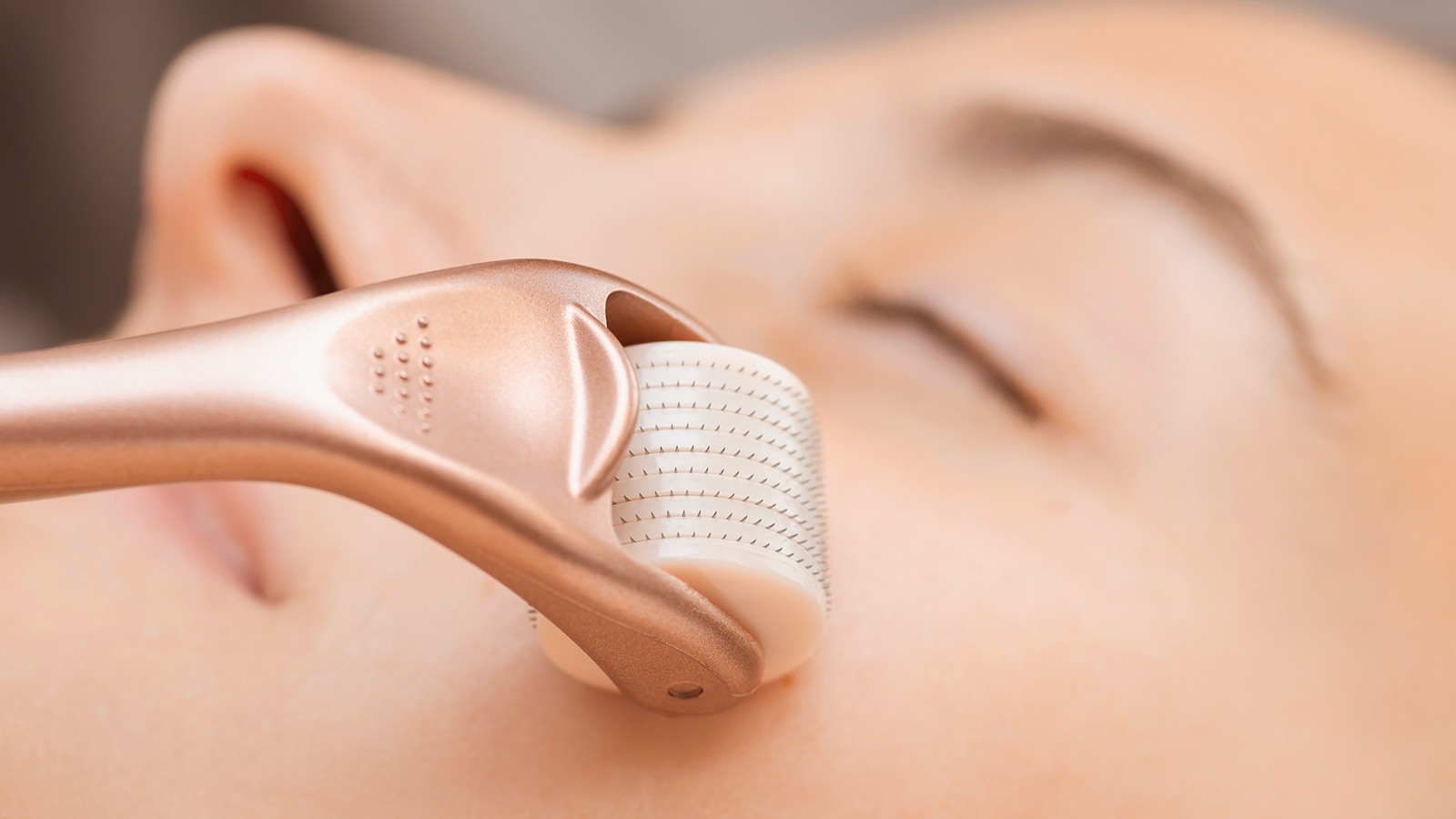
Transdermal therapy has emerged as a promising approach in the field of cosmetics, offering innovative solutions for skin care and treatment.
The application of hydrogel patches for periorbital eye care or acne management and sheet masks loaded with high content of hydrating and skin care actives has become common. Research has moved beyond the use of pegylated peptides and chemical penetration enhancement techniques to more sophisticated approaches.1 This article focuses on two physical enhancement methods, microneedles, and laser-assisted therapy, which are starting to gain attention in cosmetic applications.
Microneedles in Cosmetic Applications
Microneedles (MNs) have gained significant attention in the cosmetic industry due to their ability to enhance the delivery of active ingredients through the skin. Unlike traditional needles, MNs are minimally invasive, reducing pain and infection risks while improving drug delivery control.2 They are particularly effective in delivering nutrients, promoting skin healing, and enhancing the penetration of cosmeceuticals.3,4 The development of microfabrication technologies has enabled the production of MNs in various sizes and materials, allowing for the loading of cosmetic compounds. Dissolving microneedles, for instance, have shown superior efficacy in transdermal drug delivery, offering a promising alternative to traditional methods.3,5
Laser-Assisted Therapy
Laser-assisted therapy is a cutting-edge technique that enhances the penetration of cosmetic agents by temporarily disrupting the skin barrier. This method is often combined with other transdermal technologies, such as MNs and nanocarriers, to improve therapeutic efficacy.1The use of lasers in cosmetic applications has been shown to stimulate the skin’s self-repair mechanisms, promoting aesthetic restoration and enhancing the delivery of cosmetic agents. However, the high cost and need for expert led therapy remain challenges that need to be addressed for wider home-use adoption.1,6
Challenges and Future Perspectives
Despite the promising potential of transdermal therapy in cosmetics, several challenges remain. The skin’s barrier function, primarily the stratum corneum, limits the penetration and absorption of active ingredients. To overcome this, various enhancement strategies, such as chemical enhancers and physical methods like iontophoresis and sonophoresis, have been explored. These methods aim to modify the stratum corneum’s structure, improving drug permeability and efficacy.6 The commercialization of transdermal technologies also faces hurdles, including regulatory approval, safety concerns, and production scalability3,5. Ongoing research and innovation are crucial to address these challenges and fully realize the potential of transdermal therapy in cosmetics. The integration of advanced technologies, such as nanocarriers and active transdermal devices, holds promise for more effective and personalized cosmetic treatments.1,4In conclusion, transdermal therapy approaches, including MNs, and laser-assisted therapy, offer innovative solutions for cosmetic applications. These methods enhance the delivery and efficacy of active ingredients, providing improved skin care and treatment options. However, challenges related to safety and commercialization need to be addressed to fully harness the potential of these technologies in the cosmetic industry.
References:
1 Scott JA, Banga AK. Cosmetic devices based on active transdermal technologies. Ther Deliv. 2015;6(9):1089–99.
2 MDPen Skincare [Internet]. [cited 2025 Apr 13]. Home. Available from: https://mdpen.co/
3 Rajput A, Patil A, Kandhare P, Pawar A. Application of microneedle arrays in cosmetics: Promises, advances, and challenges. Med Nov Technol Devices. 2024 Dec 1;24:100325.
4 Kang Y, Zhang S, Wang G, Yan Z, Wu G, Tang L, et al. Nanocarrier-Based Transdermal Drug Delivery Systems for Dermatological Therapy. Pharmaceutics. 2024 Nov;16(11):1384.
5 Wu C, Yu Q, Huang C, Li F, Zhang L, Zhu D. Microneedles as transdermal drug delivery system for enhancing skin disease treatment. Acta Pharm Sin B. 2024 Dec 1;14(12):5161–80.
6 Kim B, Cho HE, Moon SH, Ahn HJ, Bae S, Cho HD, et al. Transdermal delivery systems in cosmetics. Biomed Dermatol. 2020 Apr 7;4(1):10.

Rachna Rastogi
Bregma Science LLP, Bangalore, Karnataka, India, www.bregma.org

Anjali Gholap
Bregma Science LLP, Bangalore, Karnataka, India, www.bregma.org