The task of emulsifiers is to combine non-miscible liquids such as water and oil in cosmetic products to form an emulsion. A new blend of natural emulsifiers also shows antimicrobial properties. Nargiza Cakir, Dr Malte Sietzen and Dr Fernando Ibarra have studied the advantages that result in the manufacture of cosmetic products.
The personal care market can be divided into different segments like toiletries, colour cosmetics, hair care, oral care, fragrances, and skin care. The latter plays a major role in terms of the share of the total market size in most countries. Therefore, skin care products are among the most important products for most manufacturers of personal care products.
Let us take a closer look into emulsion technology which is the base for the skin care segment in the cosmetics industry. An emulsion is a small miracle that cosmetic formulators and manufacturers fulfil whenever they put oil and water together into a stable product. Normally, these components will not mix unless there is a substance used that will form an interface between the two and let them coexist in the cream-jar. So, what is this magical glue that holds water and oil together to form an emulsion?
Superpowers of emulsifiers
The reason that water and oil won’t mix is a combination of molecular forces within these liquids. Water has strong intramolecular forces, the hydrogen bonds, that give this liquid very special properties (like a very high boiling point despite the small molecular weight). Oils, in contrast have so-called van-der-Waals bonds that hold them together. These two forces are different, and the result is that each liquid is happy on its own and when brought together they separate immediately because of another strong force, the surface tension between the two, that drives them apart.
Emulsifiers can lower the surface tension between water and oil and allow to form very small droplets of one liquid (the dispersed – or inner – phase) in the other (the continuous – or outer – phase). Thus, the two liquids are still not really dissolved into each other, but we are able to bring them very close together in a homogeneous dispersion, the emulsion.
Ever since scientists have started using emulsions, there has been the need for emulsifiers. In this evolution of emulsifiers, technology has evolved and the first emulsifiers that have been found in nature (Lecithins) have been replaced by modern emulsifiers with better performance. Today there is a large variety of non-ionic and anionic emulsifiers and to a lesser extend cationic emulsifiers. In line with global consumer trends there are many vegetable-based, sustainable emulsifiers on the market with different properties and sensorial profiles.
Multifunctional emulsifier blends
In the last decades, emulsifier blends have become very successful and are an important element in the toolbox of cosmetic formulators. Emulsifier blends contain different functional elements that improve the performance, versatility, and manageability of emulsifiers, while decreasing complexity in formulating, warehouse space and energy consumption in the life cycle of cosmetic products.
In a study aiming at the development of a universal oil in water emulsifier with as many as possible benefits, first there was an evaluation of different main emulsifiers for their versatility and stability in simple emulsions. Dozens of formulations have been made, utilising many different oil types (triglycerides, esters, hydrocarbons) with different oil phase sizes and various emulsifier concentrations to find a powerful main emulsifier. Glyceryl Stearate Citrate gave the best results both in handling and simulated long term stability testing and thus was the choice as the main ingredient in this new blend.
The next step was to find a perfectly compatible co-emulsifier, that would further improve the emulsion stability and add extra functions such as an improved consistency and sensorial benefits. A screening of natural based co-emulsifiers revealed the right companion for the vegetal-derived emulsifier: the well-known fatty alcohol mixture Cetearyl Alcohol.
The most interesting part though is the third component, which was included to bring totally new and surprising benefits. As co-emulsifiers usually occupy the space between the lipophilic parts of the main emulsifier molecules, it was theorised that adding an additional amphiphilic substance with a shorter carbon chain could lead to further emulsion stabilisation through incorporation in smaller, previously uninhabited sections of the interphase. To achieve this goal, the compound Glyceryl Laurate, a more polar co-emulsifier with a medium carbon chain length, was selected. Care must be taken regarding the chosen ratio of the three ingredients. It is imperative that the more polar Glyceryl Laurate is present only in small amounts, as higher concentrations quickly elicit emulsion destabilisation.
The inclusion of Glyceryl Laurate provided the emulsifier blend with several positive side effects: The melting point was reduced to about 60°C allowing for lower temperature workflows, an antimicrobial boosting effect was added to the blend, and sensory benefits such as a light skin feel were discovered. The result is a completely natural emulsifier blend that is not only highly versatile in its emulsification function but adds a multitude of further benefits.
A versatile emulsifier blend
The new emulsifier blend1 presented here is a composition of three natural components: Glyceryl Stearate Citrate, Cetearyl Alcohol and Glyceryl Laurate. All materials and the final composition have been approved by Cosmos/Ecocert and NaTrue for the use in certified natural cosmetics.
The two main constituents, Glyceryl Stearate Citrate and Cetearyl Alcohol are two well-known components in emulsions. However, the in-corporation of Glyceryl Laurate is a game changer for the performance. The small molecule and wetting agent brings a new dynamic into the emulsification process by being much faster in assembling the interphase between water and oil.
As a further benefit, it also lowers the melting point of the blend, so that it melts already at approx. 60°C during manufacturing and will save time and energy in the process. At the same time, this property makes the emulsifier blend workable into pellets, which are easy to handle and dose for manufacturers. Table 1 shows common formulation concepts and application data.
The addition of a medium chain co-emulsifier also changes the sensorial profile of the finished product. The spreadability of the emulsion is faster and the skin feel is perceived as lighter. This is a very good starting point for many formulations that should have a good spreadability, light skin feel and good absorbance or skin penetration.
A further benefit is the preservative boosting effect that Glyceryl Laurate delivers in this blend. Glyceryl Laurate has been known since the ground-breaking studies of Jon J. Kabara in the early 1960’s as a strong natural antimicrobial that is found in human breastmilk and has since proved itself as an efficient antimicrobial against many microorganisms. The substance is well known in pharmacological studies, the food industry and as nutritional supplement.
Surprisingly the personal care industry has paid little attention to this multifunctional ingredient so far. As nowadays the preservation of emulsions seldomly relies on one single powerful preservative, but more often on a combination of different mild antimicrobials acting in unison, this remarkable benefit of the emulsifier blend is especially welcome to many formulators.
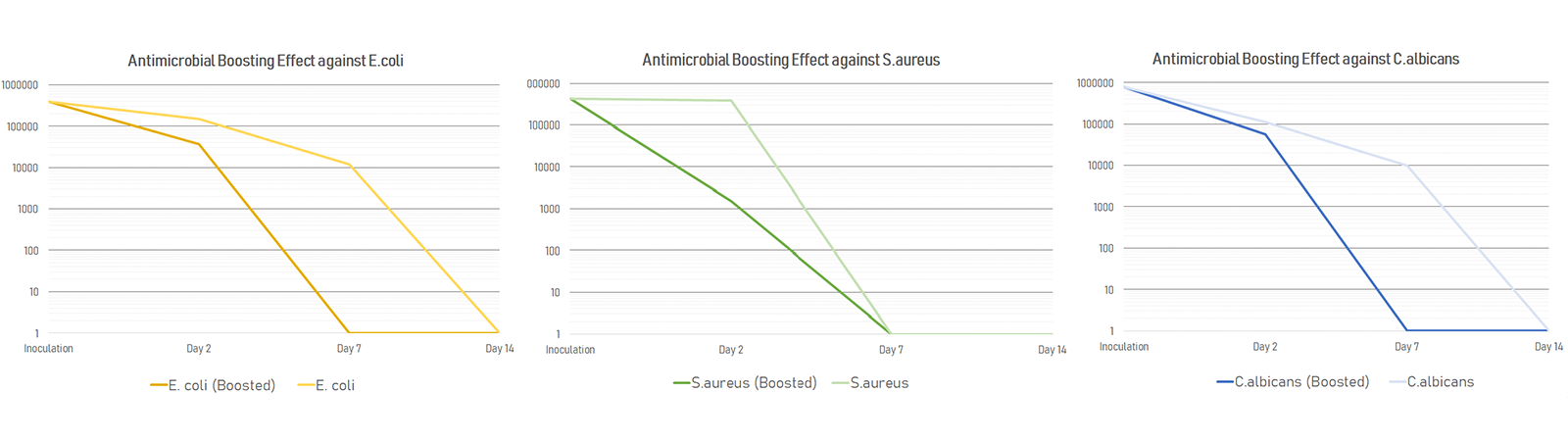
In challenge test studies, it was found that the presence of Glyceryl Laurate in the emulsifier blend boosts the efficiency against three of the five standard challenge test organisms E.coli, S.aureus and C.albicans (figure 1). As a preservation system in this test matrix, intentionally underdosed organic acids have been used, which are often chosen for the protection of emulsions.
Apart from these beneficial auxiliary functions, the emulsifier blend offers outstanding emulsifying properties. Emulsions produced with this blend are highly stable and can be, depending on the composition, thick, rich, and caring, or light and only slightly viscous, or even sprayable. Any type of oil and oil phase size is tolerated if the emulsifier concentration is adjusted appropriately.
To further substantiate the versatility, it was made sure that no adverse incompatibilities with common cosmetic ingredient classes such as anionic or inorganic surfactants, SFPs, thickeners and electrolytes exist. To this end there were evaluated viscosity changes in emulsions by means of a Brookfield spindle viscosimeter in the first 72 hours after the emulsification step with various additives and under different pH conditions. While the expected effect on the emulsion thickness is noticeable in some instances, no severe loss of viscosity was observed. The same is true for the four different pH values at which the emulsifier blend was applied. Furthermore, simulated long term storage was tested through centrifugation and elevated temperatures. No cases of emulsion destabilisation were observed.
Conclusion
In summary, the main benefits of the powerful emulsifier blend that is based on the all-natural ingredients Glyceryl Stearate Citrate, Cetearyl Alcohol and Glyceryl Laurate, are the tremendous application versatility, ease of handling, and functional benefits it brings to formulations. Emulsions produced with this easy-to-use pelletised blend display an improved light skin feel and low stickiness. In addition to the sensory properties, the emulsifier blend acts as an antimicrobial boosting agent, allowing reduced concentrations of preservatives. Many kinds of different formulation types are accessible – from light bodymilks or even sprayable sunscreens to rich and caring creams. It is compatible with all common natural cosmetics standards such as Cosmos and Natrue.
References
1 Evicare emulgiza light

Nargiza Cakir, Formulation Chemist, Evident Ingredients, Hamburg, Germany, www.evident-ingredients.com
Co-authors:
Dr Fernando Ibarra, Managing Director, Evident Ingredients, Hamburg, Germany, www.evident-ingredients.com
Dr Malte Sietzen, Head of R&D and Quality, Evident Ingredients, Hamburg, Germany, www.evident-ingredients.com